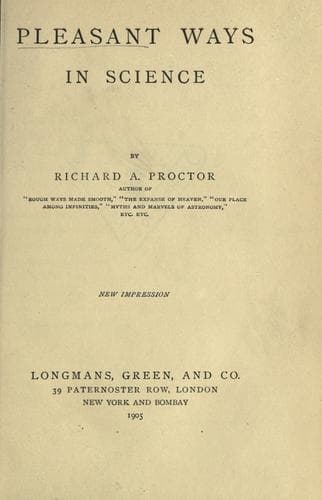
Pleasant Ways in ScienceProctor, Richard A. (Richard Anthony)
Science
Pleasant Ways in Science
Proctor, Richard A. (Richard Anthony)
Science
But this is little. Wonderful as is the extent of the sidereal system
as thus viewed, even more wonderful is its infinite variety. We know
how largely modern discoveries have increased our estimate of the
complexity of the planetary system. Where the ancients recognized
but a few planets, we now see, besides the planets, the families of
satellites; we see the rings of Saturn, in which minute satellites must
be as the sands on the sea-shore for multitude; the wonderful zone
of asteroids; myriads on myriads of comets; millions on millions of
meteor-systems, gathering more and more richly around the sun, until
in his neighbourhood they form the crown of glory which bursts into
view when he is totally eclipsed. But wonderful as is the variety seen
within the planetary system, the variety within the sidereal system is
infinitely more amazing. Besides the single suns, there are groups and
systems and streams of primary suns; there are whole galaxies of minor
orbs; there are clustering stellar aggregations, showing every variety
of richness, of figure, and of distribution; there are all the various
forms of nebulæ, resolvable and irresolvable, circular, elliptical,
and spiral; and lastly, there are irregular masses of luminous gas,
clinging in fantastic convolutions around stars and star-systems. Nor
is it unsafe to assert that other forms and variety of structure will
yet be discovered, or that hundreds more exist which we may never hope
to recognize.
But lastly, even more wonderful than the infinite variety of the
sidereal system, is its amazing vitality. Instead of millions of inert
masses, we see the whole heavens instinct with energy—astir with busy
life. The great masses of luminous vapour, though occupying countless
millions of cubic miles of space, are moved by unknown forces like
clouds before the summer breeze; star-mist is condensing into clusters;
star-clusters are forming into suns; streams and clusters of minor orbs
are swayed by unknown attractive energies; and primary suns singly or
in systems are pursuing their stately path through space, rejoicing as
giants to run their course, extending on all sides the mighty arm of
their attraction, gathering from ever-new regions of space supplies of
motive energy, to be transformed into the various forms of force—light
and heat and electricity—and distributed in lavish abundance to the
worlds which circle round them.
Truly may I say, in conclusion, that whether we regard its vast extent,
its infinite variety, or the amazing vitality which pervades its every
portion, the sidereal system is, of all the subjects man can study,
the most imposing and the most stupendous. It is as a book full of
mighty problems—of problems which are as yet almost untouched by man,
of problems which it might seem hopeless for him to attempt to solve.
But those problems are given to him for solution, and he _will_ solve
them, whenever he dares attempt to decipher aright the records of that
wondrous volume.
Public-domain text, read in full here on John Shaqi.
Reviews
Reviews
No reviews yet
Be the first to share your thoughts on this work.
Elsewhere in the archive
Join the Discussion
Join the discussion
Sign in to leave a comment or review.
Sign InorCreate an account