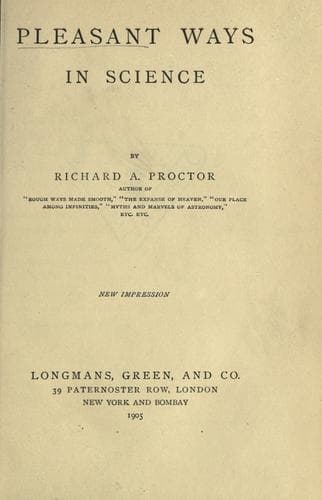
Pleasant Ways in ScienceProctor, Richard A. (Richard Anthony)
Science
Pleasant Ways in Science
Proctor, Richard A. (Richard Anthony)
Science
Another inviting theory is that according to which the earth is
regarded as a mere shell of solid matter surrounding a molten nucleus.
There is every reason to believe that the whole interior of the earth
is in a state of intense heat; and if the increase of heat with depth
(as shown in our mines) is supposed to continue uniformly, we find that
at very moderate depths a degree of heat must prevail sufficient to
liquefy any known solids under ordinary conditions. But the conditions
under which matter exists a few miles only below the surface of the
earth are not ordinary. The pressure enormously exceeds any which our
physicists can obtain experimentally. The ordinary distinction between
solids and liquids cannot exist at that enormous pressure. A mass
of cold steel could be as plastic as any of the glutinous liquids,
while the structural change which a solid undergoes in the process
of liquefying could not take place under such pressure even at an
enormously high temperature. It is now generally admitted that if the
earth really has a molten nucleus, the solid crust must, nevertheless,
be far too thick to be in any way disturbed by changes affecting the
liquid matter beneath.
Yet another theory has found advocates. The mathematician Hopkins,
whose analysis of the molten-nucleus theory was mainly effective in
showing that theory to be untenable, suggested that there may be
isolated subterranean lakes of fiery matter, and that these may be the
true seat of volcanic energy. But such lakes could not maintain their
heat for ages, if surrounded (as the theory requires) by cooler solid
matter, especially as the theory also requires that water should have
access to them. It will be observed also that none of the theories just
described affords any direct account of those various features of the
earth’s surface—mountain ranges, table-lands, volcanic regions, and so
on—which are undoubtedly due to the action of subterranean forces. The
theory advanced by Mr. Mallet is open to none of these objections. It
seems, indeed, competent to explain all the facts which have hitherto
appeared most perplexing.
Public-domain text, read in full here on John Shaqi.
Reviews
Reviews
No reviews yet
Be the first to share your thoughts on this work.
Elsewhere in the archive
Join the Discussion
Join the discussion
Sign in to leave a comment or review.
Sign InorCreate an account