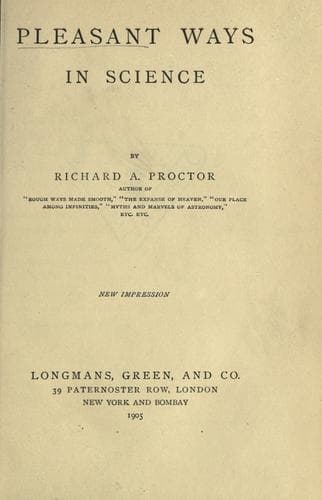
Pleasant Ways in ScienceProctor, Richard A. (Richard Anthony)
Science
Pleasant Ways in Science
Proctor, Richard A. (Richard Anthony)
Science
_MALLET’S THEORY OF VOLCANOES._
There are few subjects less satisfactorily treated in scientific
treatises than that which Humboldt calls the Reaction of the Earth’s
Interior. We find, not merely in the configuration of the earth’s
crust, but in actual and very remarkable phenomena, evidence of
subterranean forces of great activity; and the problems suggested seem
in no sense impracticable: yet no theory of the earth’s volcanic energy
has yet gained general acceptance. While the astronomer tells us of the
constitution of orbs millions of times further away than our own sun,
the geologist has hitherto been unable to give an account of the forces
which agitate the crust of the orb on which we live.
The theory put forward respecting volcanic energy, however, by the
eminent seismologist Mallet, promises not merely to take the place
of all others, but to gain a degree of acceptance which has not been
accorded to any theory previously enunciated. It is, in principle,
exceedingly simple, though many of the details (into which I do not
propose to enter) involve questions of considerable difficulty.
Let us, in the first place, consider briefly the various explanations
which had been already advanced.
There was first the chemical theory of volcanic energy, the favourite
theory of Sir Humphry Davy. It is possible to produce on a small scale
nearly all the phenomena due to subterranean activity, by simply
bringing together certain substances, and leaving them to undergo
the chemical changes due to their association. As a familiar instance
of explosive action thus occasioned, we need only mention the results
experienced when any one unfamiliar with the methods of treating
lime endeavours over hastily to “slake” or “slack” it with water.
Indeed, one of the strong points of the chemical theory consisted in
the circumstance that volcanoes only occur where water can reach the
subterranean regions—or, as Mallet expresses it, that “without water
there is no volcano.” But the theory is disposed of by the fact, now
generally admitted, that the chemical energies of our earth’s materials
were almost wholly exhausted before the surface was consolidated.
Public-domain text, read in full here on John Shaqi.
Reviews
Reviews
No reviews yet
Be the first to share your thoughts on this work.
Elsewhere in the archive
Join the Discussion
Join the discussion
Sign in to leave a comment or review.
Sign InorCreate an account