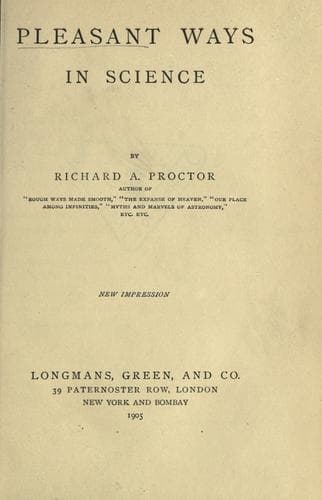
Pleasant Ways in ScienceProctor, Richard A. (Richard Anthony)
Science
Pleasant Ways in Science
Proctor, Richard A. (Richard Anthony)
Science
Scoresby in 1806 had made thus far the most northerly voyage in a ship
on Hudson’s route, but in 1868 a Swedish expedition attained higher
latitudes than had ever or have ever been reached by a ship in that
direction. The steamship _Sofia_, strongly built of Swedish iron, and
originally intended for winter voyages in the Baltic, was selected for
the voyage. Owing to a number of unfortunate delays, it was not until
September, 1868, that the _Sofia_ reached the most northerly part of
her journey, attaining a point nearly fifteen miles further north than
Hudson had reached. To the north broken ice was still found, but it was
so closely packed that not even a boat could pass through. Two months
earlier in the season the voyagers might have waited for a change of
wind and the breaking up of the ice; but in the middle of September
this would have been very dangerous. The temperature was already
sixteen degrees below the freezing-point, and there was every prospect
that in a few weeks, or even days, the seas over which they had reached
their present position would be icebound. They turned back from that
advanced position; but, with courage worthy of the old Vikings, they
made another attack a fortnight later. They were foiled again, as was
to be expected, for by this time the sun was already on the wintry side
of the equator. They had, indeed, a narrow escape from destruction.
“An ice-block with which they came into collision opened a large leak
in the ship’s side, and when, after great exertions, they reached the
land, the water already stood two feet over the cabin floor.”[21]
On the western side of the North Atlantic Channel—so to term the part
lying between Greenland and Spitzbergen—the nearest approach towards
the Pole was made by the Dutch in 1670, nearly all the more recent
attempts to reach high northern latitudes in this direction having
hitherto ended in failure more or less complete.
Public-domain text, read in full here on John Shaqi.
Reviews
Reviews
No reviews yet
Be the first to share your thoughts on this work.
Elsewhere in the archive
Join the Discussion
Join the discussion
Sign in to leave a comment or review.
Sign InorCreate an account