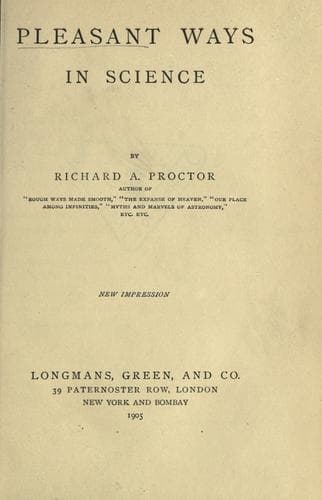
Pleasant Ways in ScienceProctor, Richard A. (Richard Anthony)
Science
Pleasant Ways in Science
Proctor, Richard A. (Richard Anthony)
Science
by the ice that her crew had to leave her, wintering on Lyttelton
Island. They left this spot in the early summer of 1872, in two boats,
and were eventually picked up by a Scotch whaler.
Captain Nares’s expedition followed Hall’s route. I do not propose to
enter here into any of the details of the voyage, with which my readers
are no doubt familiar. The general history of the expedition must be
sketched, however, in order to bring it duly into its place here. The
_Alert_ and _Discovery_ sailed under Captains Nares and Stephenson, in
May, 1875. Their struggle with the ice did not fairly commence until
they were nearing the 79th parallel, where Baffin’s Bay merges into
Smith’s Sound. Thence, through Smith’s Sound, Kennedy Channel, and
Robeson Channel, they had a constant and sometimes almost desperate
struggle with the ice, until they had reached the north end of Robeson
Channel. Here the _Discovery_ took up her winter quarters, in north
latitude 81° 44´, a few miles north of Captain Hall’s wintering-place,
but on the opposite (or westerly) side of Robeson Channel. The _Alert_
still struggled northwards, rounding the north-east point of Grant
Land, and there finding, not, as was expected, a continuous coast-line
on the west, but a vast icebound sea. No harbour could be found, and
the ship was secured on the inside of a barrier of grounded ice, in
latitude 82° 31´, in the most northerly wintering-place ever yet
occupied by man. The ice met with on this sea is described as “of most
unusual age and thickness, resembling in a marked degree, both in
appearance and formation, low floating icebergs rather than ordinary
salt-water ice. Whereas ordinary ice is from 2 feet to 10 feet in
thickness, that in this Polar sea has gradually increased in age and
thickness until it measures from 80 feet to 120 feet, floating with
its surface at the lower part 15 feet above the water-line. In some
places the ice reaches a thickness of from 150 to 200 feet, and the
general impression among the officers of the expedition seems to have
been that the ice of this Palæocrystic Sea is the accumulation of many
years, if not of centuries; “that the sea is never free of it and never
open; and that progress to the Pole through it or over it is impossible
with our present resources.”
The winter which followed was the bitterest ever known by man. For
142 days the sun was not seen; the mercury was frozen during nearly
nine weeks. On one occasion the thermometer showed 104° below the
freezing-point, and during one terrible fortnight the mean temperature
was 91° below freezing!
Public-domain text, read in full here on John Shaqi.
Reviews
Reviews
No reviews yet
Be the first to share your thoughts on this work.
Elsewhere in the archive
Join the Discussion
Join the discussion
Sign in to leave a comment or review.
Sign InorCreate an account