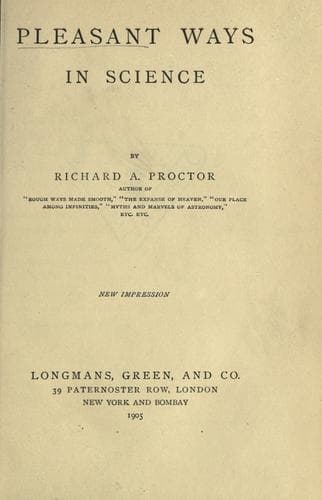
Pleasant Ways in ScienceProctor, Richard A. (Richard Anthony)
Science
Pleasant Ways in Science
Proctor, Richard A. (Richard Anthony)
Science
As soon as the sun reappeared sledge-exploration began, each ship being
left with only half-a-dozen men and officers on board. Expeditions were
sent east and west, one to explore the northern coast of Greenland, the
other to explore the coast of Grant Land. Captain Stephenson crossed
over from the _Discovery’s_ wintering-place to Polaris Bay, and there
placed over Hall’s grave a tablet, prepared in England, bearing the
following inscription: “Sacred to the memory of Captain C. F. Hall, of
U.S. _Polaris_, who sacrificed his life in the advancement of science,
on November 8, 1871. This tablet has been erected by the British Polar
Expedition of 1875, who, following in his footsteps, have profited by
his experience”—a graceful acknowledgment (which might, however, have
been better expressed). The party which travelled westwards traced
the shores of Grant Land as far as west longitude 86° 30´, the most
northerly cape being in latitude 83° 7´, and longitude 70° 30´ west.
This cape they named Cape Columbia.
The coast of Greenland was explored as far east as longitude 50° 40´
(west), land being seen as far as 82° 54´ north, longitude 48° 33´
west. Lastly, a party under Commander Markham and Lieutenant Parr
pushed northwards. They were absent ten weeks, but had not travelled
so far north in the time as was expected, having encountered great
difficulties. On May 12, 1876, they reached their most northerly point,
planting the British flag in latitude 83° 20´ 26´´ north. “Owing to
the extraordinary nature of the pressed-up ice, a roadway had to be
formed by pickaxes for nearly half the distance travelled, before any
advance could be safely made, even with light loads; this rendered it
always necessary to drag the sledge-loads forward by instalments, and
therefore to journey over the same road several times. The advance was
consequently very slow, and only averaged about a mile and a quarter
daily—much the same rate as was attained by Sir Edward Parry during
the summer of 1827. The greatest journey made in any one day amounted
only to two miles and three quarters. Although the distance made good
was only 73 miles from the ship, 276 miles were travelled over to
accomplish it.” It is justly remarked, in the narrative from which I
have made this extract, that no body of men could have surpassed in
praiseworthy perseverance this gallant party, whose arduous struggle
over the roughest and most monotonous road imaginable, may fairly be
regarded as surpassing all former exploits of the kind. (The narrator
says that it has “eclipsed” all former ones, which can scarcely be
intended to be taken _au pied de la lettre_.) The expedition reached
the highest latitude ever yet attained under any conditions, carried
a ship to higher latitudes than any ship had before reached, and
wintered in higher latitudes than had ever before been dwelt in during
the darkness of a Polar winter. They explored the most northerly
Public-domain text, read in full here on John Shaqi.
Reviews
Reviews
No reviews yet
Be the first to share your thoughts on this work.
Elsewhere in the archive
Join the Discussion
Join the discussion
Sign in to leave a comment or review.
Sign InorCreate an account