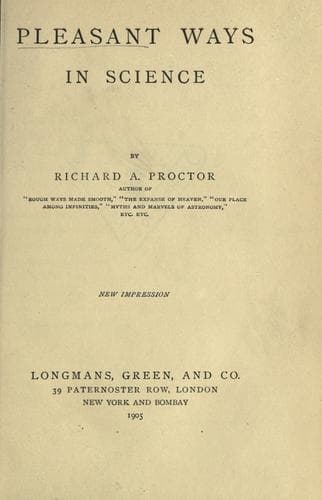
Pleasant Ways in ScienceProctor, Richard A. (Richard Anthony)
Science
Pleasant Ways in Science
Proctor, Richard A. (Richard Anthony)
Science
There is one point which suggests itself very forcibly in reading the
account of the sledging expedition from the _Alert_ towards the north.
In his official report, Captain Nares says that “half of each day was
spent in dragging the sledges in that painful fashion—face toward the
boat—in which the sailors drag a boat from the sea on to the sand;”
and again he speaks of the “toilsome dragging of the sledges over
ice-ridges which resembled a stormy sea suddenly frozen.” In doing
this “276 miles were toiled over in travelling only 73 miles.” Is it
altogether clear that the sledges were worth the trouble? One usually
regards a sledge as intended to carry travellers and their provisions,
etc., over ice and snow, and as useful when so employed; but when the
travellers have to take along the sledge, going four times as far and
working ten times as hard as if they were without it, the question
suggests itself whether all necessary shelter, provisions, and utensils
might not have been much more readily conveyed by using a much smaller
and lighter sledge, and by distributing a large part of the luggage
among the members of the expedition. The parts of a small hut could,
with a little ingenuity, be so constructed as to admit of being used as
levers, crowbars, carrying-poles, and so forth, and a large portion of
the luggage absolutely necessary for the expedition could be carried by
their help; while a small, light sledge for the rest could be helped
along and occasionally lifted bodily over obstructions by levers and
beams forming part of the very material which by the usual arrangement
forms part of the load. I am not suggesting, be it noticed, that by any
devices of this sort a journey over the rough ice of Arctic regions
could be made easy. But it does seem to me that if a party could go
back and forth over 276 miles, pickaxing a way for a sledge, and
eventually dragging it along over the path thus pioneered for it, and
making only an average of 1¼ mile of real progress per day, or 73 miles
in all, the same men could with less labour (though still, doubtless,
with great toil and trouble) make six or seven miles a day by reducing
their _impedimenta_ to what could be carried directly along with them.
Whether use might not be made of the lifting power of buoyant gas, is
a question which only experienced aëronauts and Arctic voyagers could
answer. I believe that the employment of imprisoned balloon-power for
many purposes, especially in time of war, has received as yet much less
attention than it deserves. Of course I am aware that in Arctic regions
many difficulties would present themselves; and the idea of ordinary
ballooning over the Arctic ice-fields may be regarded as altogether
wild in the present condition of the science of aëronautics. But the
use of balloon-power as an auxiliary, however impracticable at present,
is by no means to be despaired of as science advances.
Public-domain text, read in full here on John Shaqi.
Reviews
Reviews
No reviews yet
Be the first to share your thoughts on this work.
Elsewhere in the archive
Join the Discussion
Join the discussion
Sign in to leave a comment or review.
Sign InorCreate an account