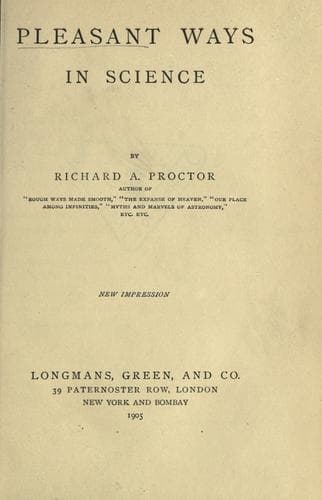
Pleasant Ways in ScienceProctor, Richard A. (Richard Anthony)
Science
Pleasant Ways in Science
Proctor, Richard A. (Richard Anthony)
Science
After all, however, the advance upon the Pole itself, however
interesting to the general public, is far less important to science
than other objects which Arctic travellers have had in view. The
inquiry into the phenomena of terrestrial magnetism within the Arctic
regions; the investigation of oceanic movements there; of the laws
according to which low temperatures are related to latitude and
geographical conditions; the study of aerial phenomena; of the limits
of plant life and animal life; the examination of the mysterious
phenomena of the Aurora Borealis—these and many other interesting
subjects of investigation have been as yet but incompletely dealt with.
In the Polar regions, as Maury well remarked, “the icebergs are framed
and glaciers launched; there the tides have their cradle, the whales
their nursery; there the winds complete their circuit, and the currents
of the sea their round, in the wonderful system of oceanic circulation;
there the Aurora is lighted up, and the trembling needle brought to
rest; and there, too, in the mazes of that mystic circle, terrestrial
forces of occult power and of vast influence upon the well-being of man
are continually at work. It is a circle of mysteries; and the desire to
enter it, to explore its untrodden wastes and secret chambers, and to
study its physical aspects, has grown into a longing. Noble daring has
made Arctic ice and snow-clad seas classic ground.”
_A MIGHTY SEA-WAVE._
On May 10th, 1876, a tremendous wave swept the Pacific Ocean from Peru
northwards, westwards, and southwards, travelling at a rate many times
greater than that of the swiftest express train. For reasons best known
to themselves, writers in the newspapers have by almost common consent
called this phenomenon a tidal-wave. But the tides had nothing to do
with it. Unquestionably the wave resulted from the upheaval of the bed
of the ocean in some part of that angle of the Pacific Ocean which is
bounded by the shores of Peru and Chili. This region has long been
celebrated for tremendous submarine and subterranean upheavals. The
opinions of geologists and geographers have been divided as to the real
origin of the disturbances by which at one time the land, at another
time the sea, and at yet other times (oftener, in fact, than either
of the others) both land and sea have been shaken as by some mighty
imprisoned giant, struggling, like Prometheus, to cast from his limbs
the mountain masses which hold them down. Some consider that the seat
of the Vulcanian forces lies deep below that part of the chain of the
Andes which lies at the apex of the angle just mentioned, and that the
direction of their action varies according to the varying conditions
under which the imprisoned gases find vent. Others consider that there
are two if not several seats of subterranean activity. Yet others
suppose that the real seat of disturbance lies beneath the ocean
itself, a view which seems to find support in several phenomena of
Public-domain text, read in full here on John Shaqi.
Reviews
Reviews
No reviews yet
Be the first to share your thoughts on this work.
Elsewhere in the archive
Join the Discussion
Join the discussion
Sign in to leave a comment or review.
Sign InorCreate an account