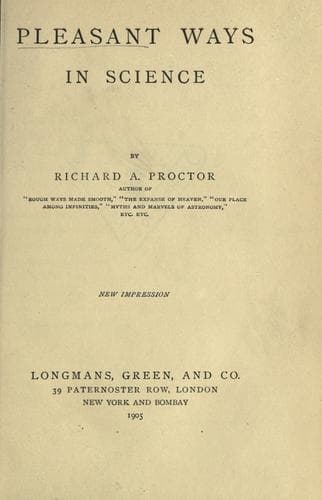
Pleasant Ways in ScienceProctor, Richard A. (Richard Anthony)
Science
Pleasant Ways in Science
Proctor, Richard A. (Richard Anthony)
Science
recent Peruvian earthquakes.
Although we have not full information concerning the great wave which
in May, 1876, swept across the Pacific, and northwards and southwards
along the shores of the two Americas, it may be interesting to consider
some of the more striking features of this great disturbance of the
so-called peaceful ocean, and to compare them with those which have
characterized former disturbances of a similar kind. We may thus,
perhaps, find some evidence by which an opinion may be formed as to the
real seat of subterranean activity in this region.
At the outset it may be necessary to explain why I have asserted
somewhat confidently that the tides have nothing whatever to do with
this great oceanic wave. It is of course well known to every reader
that the highest or spring tides occur always two or three days after
new moon and after full moon, the lowest (or rather the tides having
least range above and below the mean level) occurring two or three days
after the first and third quarters of the lunar month. The sun and moon
combine, indeed, to sway the ocean most strongly at full and new, while
they pull contrariwise at the first and third quarters; but the full
effect of their combined effort is only felt a few days later than when
it is made, while the full effect of their opposition to each other,
in diminishing the range of the oceanic oscillation, is also only felt
after two or three days. Thus in May, 1876, the tidal wave had its
greatest range on or about May 16, new moon occurring at half-past five
on the morning of May 13; and the tidal wave had its least range on or
about May 8, the moon passing her third quarter a little after eleven
on the morning of May 4. Accordingly the disturbance which affected the
waters of the Pacific so mightily on May 10, occurred two days after
the lowest or neap tides, and five days before the highest or spring
tides. Manifestly that was not a time when a tidal wave of exceptional
height could be expected, or, indeed, could possibly occur. Such a
wave as actually disturbed the Pacific on that day could not in any
case have been produced by tidal action, even though the winds had
assisted to their utmost, and all the circumstances which help to make
high tides had combined—as the greatest proximity of moon to earth,
the conjunction of moon and sun near the celestial equator, and (of
course) the exact coincidence of the time of the tidal disturbance
with that when the combined pull of the sun and moon is strongest. As,
instead, the sun was nearly eighteen degrees from the equator, the moon
more than nine, and as the moon was a full week’s motion from the part
of her path where she is nearest to the earth, while, as we have seen,
only two days had passed from the time of absolutely lowest tides, it
will be seen how utterly unable the tidal-wave must have been on the
day of the great disturbance to produce the effects presently to be
described.
Public-domain text, read in full here on John Shaqi.
Reviews
Reviews
No reviews yet
Be the first to share your thoughts on this work.
Elsewhere in the archive
Join the Discussion
Join the discussion
Sign in to leave a comment or review.
Sign InorCreate an account