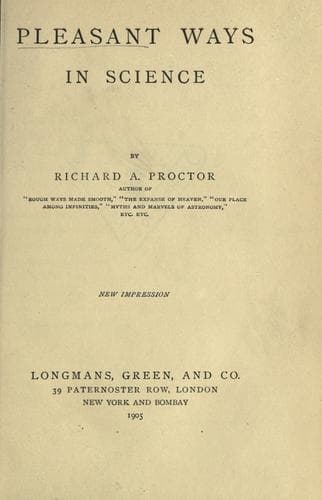
Pleasant Ways in ScienceProctor, Richard A. (Richard Anthony)
Science
Pleasant Ways in Science
Proctor, Richard A. (Richard Anthony)
Science
It is singular, by the way, how commonly the power of speech, or at
least of producing sounds resembling speech or musical notes, was
attributed to the creature which imagination converted into a man-fish
or woman-fish. Dugongs and manatees make a kind of lowing noise, which
could scarcely be mistaken under ordinary conditions for the sound of
the human voice. Yet, not only is this peculiarity ascribed to the
mermaid and siren (the merman and triton having even the supposed power
of blowing on conch-shells), but in more recent accounts of encounters
with creatures presumably of the seal tribe and allied races, the same
feature is to be noticed. The following account, quoted by Mr. Gosse
from a narrative by Captain Weddell, the well-known geographer, is
interesting for this reason amongst others. It also illustrates well
the mixture of erroneous details (the offspring, doubtless, of an
excited imagination) with the correct description of a sea creature
actually seen:—“A boat’s crew were employed on Hall’s Island, when
one of the crew, left to take care of some produce, saw an animal
whose voice was musical. The sailor had lain down, and at ten o’clock
he heard a noise resembling human cries, and as daylight in these
latitudes never disappears at this season” (the Antarctic summer),
“he rose and looked around, but, on seeing no person, returned to
bed. Presently he heard the noise again; he rose a second time, but
still saw nothing. Conceiving, however, the possibility of a boat
being upset, and that some of the crew might be clinging to detached
rocks, he walked along the beach a few steps and heard the noise more
distinctly but in a musical strain. Upon searching around, he saw an
object lying on a rock a dozen yards from the shore, at which he was
somewhat frightened. The face and shoulders appeared of human form and
of a reddish colour; over the shoulders hung long green hair; the tail
resembled that of the seal, but the extremities of the arms he could
not see distinctly. The creature continued to make a musical noise
while he gazed about two minutes, and on perceiving him it disappeared
in an instant. Immediately, when the man saw his officer, he told this
wild tale, and to add weight to his testimony (being a Romanist) he
made a cross on the sand, which he kissed, as making oath to the truth
of his statement. When I saw him he told the story in so clear and
positive a manner, making oath to its truth, that I concluded he must
really have seen the animal he described, or that it must have been the
effects of a disturbed imagination.”
Public-domain text, read in full here on John Shaqi.
Reviews
Reviews
No reviews yet
Be the first to share your thoughts on this work.
Elsewhere in the archive
Join the Discussion
Join the discussion
Sign in to leave a comment or review.
Sign InorCreate an account