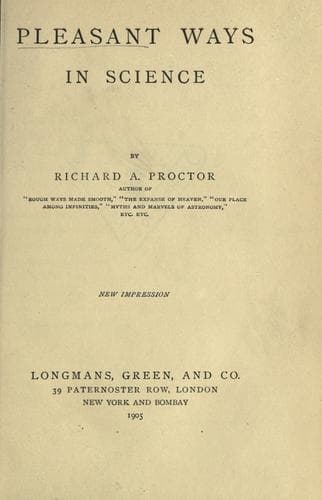
Pleasant Ways in ScienceProctor, Richard A. (Richard Anthony)
Science
Pleasant Ways in Science
Proctor, Richard A. (Richard Anthony)
Science
In this story all is consistent with the belief that the sailor saw
an animal belonging to the seal family (of a species unknown to him),
except the green hair. But the hour was not very favourable to the
discerning of colour, though daylight had not quite passed away, and as
Gosse points out, since golden-yellow fur and black fur are found among
Antarctic seals, the colours may be intermingled in some individuals,
producing an olive-green tint, which, by contrast with the reddish
skin, might be mistaken for a full green. Considering that the man had
been roused from sleep and was somewhat frightened, he would not be
likely to make very exact observations. It will be noticed that it was
only at first that he mistook the sounds made by the creature for human
cries; afterwards he heard only the same _noise_, but in a musical
strain. Now with regard to the musical sounds said to have been uttered
by this creature, and commonly attributed to creatures belonging to
families closely allied to the seals, I do not know that any attempt
has yet been made to show that these families possess the power of
emitting sounds which can properly be described as musical. It is quite
possible that the Romanist sailor’s ears were not very nice, and that
any sound softer than a bellow seemed musical to him. Still, the idea
suggests itself that possibly seals, like some other animals, possess a
note not commonly used, but only as a signal to their mates, and never
uttered when men or other animals are known to be near. It appears
to me that this is rendered probable by the circumstance that seals
are fond of music. Darwin refers to this in his treatise on Sexual
Selection (published with his “Descent of Man”), and quotes a statement
to the effect that the fondness of seals for music “was well known to
the ancients, and is often taken advantage of by hunters to the present
day.” The significance of this will be understood from Darwin’s remark
immediately following, that “with all these animals, the males of which
during the season of courtship incessantly produce musical notes or
mere rhythmical sounds, we must believe that the females are able to
appreciate them.”
The remark about the creature’s arms seems strongly to favour the
belief that the sailor intended his narrative to be strictly truthful.
Had he wished to excite the interest of his comrades by a marvellous
story, he certainly would have described the creature as having
well-developed human hands.
Less trustworthy by far seem some of the stories which have been told
of animals resembling the mermaid of antiquity. It must always be
remembered, however, that in all probability we know very few among the
species of seals and allied races, and that some of these species may
present, in certain respects and perhaps at a certain age, much closer
resemblance to the human form than the sea-lion, seal, manatee, or
dugong.
Public-domain text, read in full here on John Shaqi.
Reviews
Reviews
No reviews yet
Be the first to share your thoughts on this work.
Elsewhere in the archive
Join the Discussion
Join the discussion
Sign in to leave a comment or review.
Sign InorCreate an account