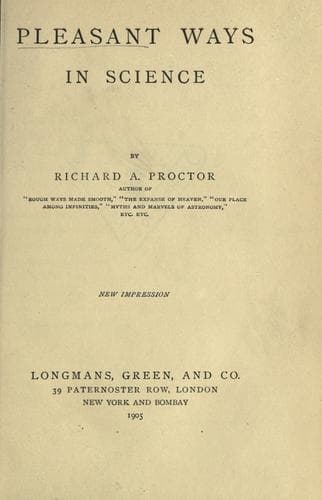
Pleasant Ways in ScienceProctor, Richard A. (Richard Anthony)
Science
Pleasant Ways in Science
Proctor, Richard A. (Richard Anthony)
Science
It is natural that animals really monstrous should be magnified by the
fears of those who have seen or encountered them, and still further
magnified afterwards by tradition. Some specimens of cuttle-fish which
have been captured wholly, or in part, indicate that this creature
sometimes attains such dimensions that but little magnifying would
be needed to suggest even the tremendous proportions of the fabulous
kraken. In 1861, the French war-steamer _Alecton_ encountered a
monstrous cuttle, on the surface of the sea, about 120 miles north-east
of Teneriffe. The crew succeeded in slipping a noose round the body,
but unfortunately the rope slipped, and, being arrested by the tail
fin, pulled off the tail. This was hauled on board, and found to weigh
over 40 lbs. From a drawing of the animal, the total length without
the arms was estimated at 50 feet, and the weight at 4000 lbs., nearly
twice the weight of Pliny’s monstrous cuttle-fish, long regarded as
fabulous. In one respect this creature seems to have been imperfect,
the two long arms usually possessed by cuttle-fish of the kind being
wanting. Probably it had lost these long tentacles in a recent
encounter with some sea enemy, perhaps one of its own species. Quite
possibly it may have been such recent mutilation which exposed this
cuttle-fish to successful attack by the crew of the _Alecton_.
A cuttle-fish of about the same dimensions was encountered by two
fishermen in 1873, in Conception Bay, Newfoundland. When they attacked
it, the creature threw its long arms across the boat, but the fishermen
with an axe cut off these tentacles, on which the cephalopod withdrew
in some haste. One of the arms was preserved, after it had lost about
6 feet of its length. Even thus reduced it measured 19 feet; and as
the fishermen estimate that the arm was struck off about 10 feet from
the body, it follows that the entire length of the limb must have
been about 35 feet. They estimated the body at 60 feet in length and
5 feet in diameter—a monstrous creature! It was fortunate for these
fishermen that they had an axe handy for its obtrusive tentacles, as
with so great a mass and the great propulsive power possessed by all
cephalopods, it might readily have upset their small boat. Once in the
water, they would have been at the creature’s mercy—a quality which,
by all accounts, the cuttle-fish does not possess to any remarkable
extent.
Turn we, however, from the half fabulous woman-fish, and the
exaggeratedly monstrous cuttle-fish, to the famous sea-serpent, held
by many to be the most utterly fabulous of all fabled creatures, while
a few, including some naturalists of distinction, stoutly maintain
that the creature has a real existence, though whether it be rightly
called a sea-serpent or not is a point about which even believers are
extremely doubtful.
Public-domain text, read in full here on John Shaqi.
Reviews
Reviews
No reviews yet
Be the first to share your thoughts on this work.
Elsewhere in the archive
Join the Discussion
Join the discussion
Sign in to leave a comment or review.
Sign InorCreate an account