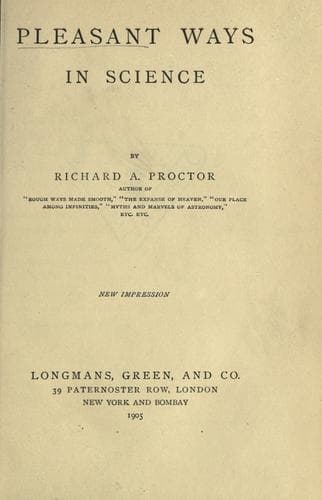
Pleasant Ways in ScienceProctor, Richard A. (Richard Anthony)
Science
Pleasant Ways in Science
Proctor, Richard A. (Richard Anthony)
Science
It may be well, in the first place, to remark that in weighing the
evidence for and against the existence of this creature, and bearing
on the question of its nature (if its existence be admitted), we ought
not to be influenced by the manifest falsity of a number of stories
relating to supposed encounters with this animal. It is probable
that, but for these absurd stories, the well-authenticated narratives
relating to the creature, whatever it may be, which has been called
the sea-serpent, would have received much more attention than has
heretofore been given to them. It is also possible that some narratives
would have been published which have been kept back from the fear
lest a truthful (though possibly mistaken) account should be classed
with the undoubted untruths which have been told respecting the great
sea-serpent. It cannot be denied that in the main the inventions and
hoaxes about the sea-serpent have come chiefly from American sources.
It is unfortunately supposed by too many of the less cultured sons of
America that (to use Mr. Gosse’s expression) “there is somewhat of wit
in gross exaggerations or hoaxing inventions.” Of course an American
gentleman—using the word “in that sense in which every man may be
a gentleman,” as Twemlow hath it—would as soon think of uttering a
base coin as a deliberate untruth or foolish hoax. But it is thought
clever, by not a few in America who know no better, to take any one in
by an invention. Some, perhaps but a small number, of the newspapers
set a specially bad example in this respect, giving room in their
columns for pretended discoveries in various departments of science,
elaborate accounts of newly discovered animals, living or extinct, and
other untruths which would be regarded as very disgraceful indeed by
English editors. Such was the famous “lunar hoax,” published in the
New York _Sun_ some forty years ago; such the narrative, in 1873, of a
monstrous fissure which had been discerned in the body of the moon, and
threatened to increase until the moon should be cloven into two unequal
parts; such the fables which have from time to time appeared respecting
the sea-serpent. But it would be as unreasonable to reject, because
of these last-named fables, the narratives which have been related by
quiet, truth-loving folk, and have borne close and careful scrutiny, as
it would be to reject the evidence given by the spectroscope respecting
the existence of iron and other metals in the sun because an absurd
story had told how creatures in the moon had been observed to make use
of metal utensils or to adorn the roofs of their temples with metallic
imitations of wreathed flames.
Public-domain text, read in full here on John Shaqi.
Reviews
Reviews
No reviews yet
Be the first to share your thoughts on this work.
Elsewhere in the archive
Join the Discussion
Join the discussion
Sign in to leave a comment or review.
Sign InorCreate an account