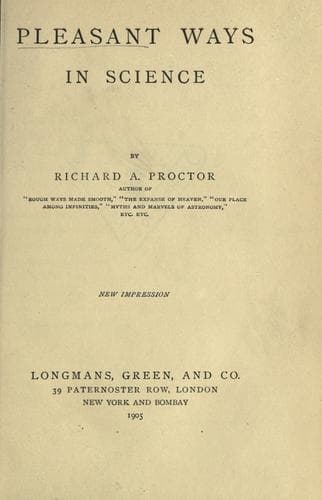
Pleasant Ways in ScienceProctor, Richard A. (Richard Anthony)
Science
Pleasant Ways in Science
Proctor, Richard A. (Richard Anthony)
Science
The progress of improvement in such methods of signalling promised to
be rapid, before the invention of the electric telegraph, or rather,
before it was shown how the principle of the electric telegraph could
be put practically into operation. We have seen that they were capable
of transmitting messages with considerable rapidity, more than twice
as fast as we could now send a written message by express train. But
they were rough and imperfect. They were all, also, exposed to one
serious defect. In thick weather they became useless. Sometimes, at the
very time when it was most important that messages should be quickly
transmitted, fog interrupted the signalling. Sir J. Barrow relates that
during the Peninsular War grave anxiety was occasioned for several
hours by the interruption of a message from Plymouth, really intended
to convey news of a victory. The words transmitted were, “Wellington
defeated;” the message of which these words formed the beginning was:
“Wellington defeated the French at,” etc. As Barrow remarks, if the
message had run, “French defeated at,” etc., the interruption of the
message would have been of less consequence.
Although the employment of electricity as a means of communicating
at a distance was suggested before the end of the last century, in
fact, so far back as 1774, the idea has only been worked out during
the last forty-two years. It is curious indeed to note that until
the middle of the present century the word “telegraph,” which is now
always understood as equivalent to electric telegraph, unless the
contrary is expressed, was commonly understood to refer to semaphore
signalling,[28] unless the word “electric” were added.
The general principle underlying all systems of telegraphic
communication by electricity is very commonly misunderstood. The idea
seems to prevail that electricity can be sent out along a wire to any
place where some suitable arrangement has been made to receive it. In
one sense this is correct. But the fact that the electricity has to
make a circuit, returning to the place from which it is transmitted,
seems not generally understood. Yet, unless this is understood, the
principle, even the possibility, of electric communication is not
recognized.
Let us, at the outset, clearly understand the nature of electric
communication.
Public-domain text, read in full here on John Shaqi.
Reviews
Reviews
No reviews yet
Be the first to share your thoughts on this work.
Elsewhere in the archive
Join the Discussion
Join the discussion
Sign in to leave a comment or review.
Sign InorCreate an account