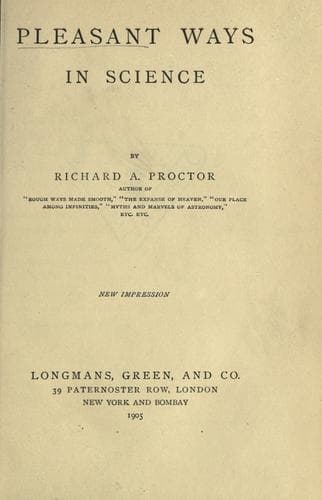
Pleasant Ways in ScienceProctor, Richard A. (Richard Anthony)
Science
Pleasant Ways in Science
Proctor, Richard A. (Richard Anthony)
Science
In a variety of ways, a certain property called electricity can be
excited in all bodies, but more readily in some than in others. This
property presents itself in two forms, which are called positive
and negative electricity, words which we may conveniently use, but
which must not be regarded as representing any real knowledge of
the distinction between these two kinds of electricity. In fact,
let it be remembered throughout, that we do not in the least know
what electricity is; we only know certain of the phenomena which
it produces. Any body which has become charged with electricity,
either positive or negative, will part with its charge to bodies in a
neutral condition, or charged with the opposite electricity (negative
or positive). But the transference is made much more readily to
some substances than to others—so slowly, indeed, to some, that in
ordinary experiments the transference may be regarded as not taking
place at all. Substances of the former kind are called good conductors
of electricity; those which receive the transfer of electricity less
readily are said to be bad conductors; and those which scarcely receive
it at all are called insulating substances. The reader must not
confound the quality I am here speaking of with readiness to become
charged with electricity. On the contrary, the bodies which most
freely receive and transmit electricity are least readily charged with
electricity, while insulating substances are readily electrified. Glass
is an insulator, but if glass is briskly rubbed with silk it becomes
charged (or rather, the part rubbed becomes charged) with positive
electricity, formerly called _vitreous_ electricity for this reason;
and again, if wax or resin, which are both good insulators, be rubbed
with cloth or flannel, the part rubbed becomes charged with negative,
formerly called _resinous_, electricity.
Public-domain text, read in full here on John Shaqi.
Reviews
Reviews
No reviews yet
Be the first to share your thoughts on this work.
Elsewhere in the archive
Join the Discussion
Join the discussion
Sign in to leave a comment or review.
Sign InorCreate an account