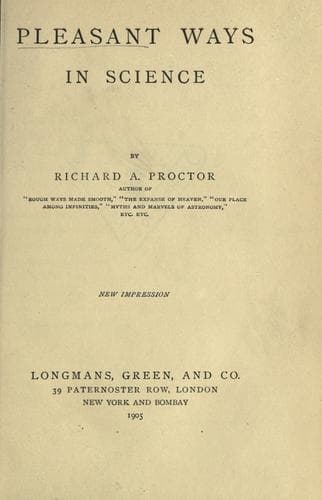
Pleasant Ways in ScienceProctor, Richard A. (Richard Anthony)
Science
Pleasant Ways in Science
Proctor, Richard A. (Richard Anthony)
Science
From Watson’s time until 1823 attempts were made in this country
and on the Continent to make the electrical machine serve as the
means of telegraphic communication. All the familiar phenomena of
the lecture-room have been suggested as signals. The motion of pith
balls, the electric spark, the perforation of paper by the spark, the
discharge of sparks on a fulminating pane (a glass sheet on which
pieces of tinfoil are suitably arranged, so that sparks passing from
one to another form various figures or devices), and other phenomena,
were proposed and employed experimentally. But practically these
methods were not effectual. The familiar phenomenon of the electric
spark explains the cause of failure. The spark indicates the passage of
electricity across an insulating medium—dry air—when a good conductor
approaches within a certain distance of the charged body. The greater
the charge of electricity, the greater is the distance over which the
electricity will thus make its escape. Insulation, then, for many miles
of wire, and still more for a complete system of communication such
as we now have, was hopeless, so long as frictional electricity was
employed, or considerable electrical intensity required.
We have now to consider how galvanic electricity, discovered in 1790,
was rendered available for telegraphic communication. In the first
place, let us consider what galvanic or voltaic electricity is.
I have said that electricity can be generated in many ways. It may
be said, indeed, that every change in the condition of a substance,
whether from mechanical causes, as, for instance, a blow, a series of
small blows, friction, and so forth, or from change of temperature,
moisture, and the like, or from the action of light, or from chemical
processes, results in the development of more or less electricity.
When a plate of metal is placed in a vessel containing some acid
(diluted) which acts chemically on the metal, this action generates
negative electricity, which passes away as it is generated. But if a
plate of a different metal, either not chemically affected by the acid
or less affected than the former, be placed in the dilute acid, the two
plates being only partially immersed and not in contact, then, when a
wire is carried from one plate to the other, the excess of positive
electricity in the plate least affected by the acid is conveyed to
the other, or, in effect, discharged; the chemical action, however,
continues, or rather is markedly increased, fresh electricity is
generated, and the excess of positive electricity in the plate least
affected is constantly discharged. Thus, along the wire connecting
the two metals a current of electricity passes from the metal least
affected to the metal most affected; a current of negative electricity
passes in a contrary direction in the dilute acid.
Public-domain text, read in full here on John Shaqi.
Reviews
Reviews
No reviews yet
Be the first to share your thoughts on this work.
Elsewhere in the archive
Join the Discussion
Join the discussion
Sign in to leave a comment or review.
Sign InorCreate an account