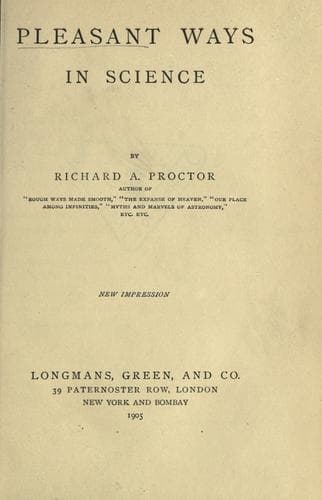
Pleasant Ways in ScienceProctor, Richard A. (Richard Anthony)
Science
Pleasant Ways in Science
Proctor, Richard A. (Richard Anthony)
Science
Electricity, then, positive or negative, however generated, passes
freely along conducting substances, but is stopped by an insulating
body, just as light passes through transparent substances, but is
stopped by an opaque body. Moreover, electricity may be made to pass
to any distance along conducting bodies suitably insulated. Thus, it
might seem that we have here the problem of distant communication
solved. In fact, the first suggestion of the use of electricity in
telegraphy was based on this property. When a charge of electricity has
been obtained by the use of an ordinary electrical machine, this charge
can be drawn off at a distant point, if a conducting channel properly
insulated connects that point with the bodies (of whatever nature)
which have been charged with electricity. In 1747, Dr. Watson exhibited
electrical effects from the discharges of Leyden jars (vessels
suitably constructed to receive and retain electricity) at a distance
of two miles from the electrical machine. In 1774, Le Sage proposed
that by means of wires the electricity developed by an electrical
machine should be transmitted by insulated wires to a point where an
electroscope, or instrument for indicating the presence of electricity,
should, by its movements, mark the letters of the alphabet, one wire
being provided for each letter. In 1798 Béthencourt repeated Watson’s
experiment, increasing the distance to twenty-seven miles, the
extremities of his line of communication being at Madrid and Aranjuez.
(Guillemin, by the way, in his “Applications of the Physical Forces,”
passes over Watson’s experiment; in fact, throughout his chapters on
the electric telegraph, the steam-engine, and other subjects, he seems
desirous of conveying as far as possible the impression that all the
great advances of modern science had their origin in Paris and its
neighbourhood.)
Public-domain text, read in full here on John Shaqi.
Reviews
Reviews
No reviews yet
Be the first to share your thoughts on this work.
Elsewhere in the archive
Join the Discussion
Join the discussion
Sign in to leave a comment or review.
Sign InorCreate an account