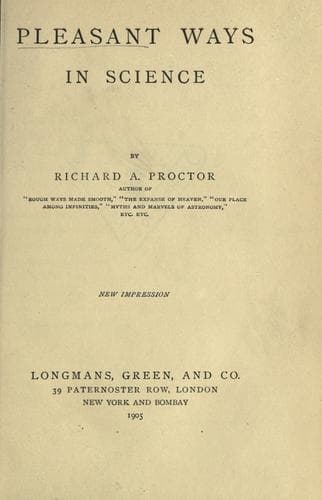
Pleasant Ways in ScienceProctor, Richard A. (Richard Anthony)
Science
Pleasant Ways in Science
Proctor, Richard A. (Richard Anthony)
Science
the same arrangement the moment of the occurrence of some phenomenon.
For if a tape be unwound automatically, as in the Morse instrument,
it is easy so to arrange matters that every second’s beat of the
pendulum records itself by a dot or short line on the tape, and that
the observer can with a touch make (or break) contact at the instant of
observation, and so a mark be made properly placed between two seconds’
marks—thus giving the precise time when the observation was made. Such
applications, however, though exceedingly interesting to astronomers,
are not among those in which the general public take chief interest.
There was one occasion, however, when astronomical time-relations were
connected in the most interesting manner with one of the greatest of
all the marvels of telegraphy: I mean, when the _Great Eastern_ in
mid-ocean was supplied regularly with Greenwich time, and this so
perfectly (and therefore with such perfect indication of her place in
the Atlantic), that when it was calculated from the time-signals that
the buoy left in open ocean to mark the place of the cut cable had been
reached, and the captain was coming on deck with several officers to
look for it, the buoy announced its presence by thumping the side of
the great ship.
_THE PHONOGRAPH, OR VOICE-RECORDER._
In the preceding essay I have described the wonderful instrument called
the telephone, which has recently become as widely known in this
country as in America, the country of its first development. I propose
now briefly to describe another instrument—the phonograph—which,
though not a telegraphic instrument, is related in some degree to the
telephone. In passing, I may remark that some, who as telegraphic
specialists might be expected to know better, have described the
phonograph as a telegraphic invention. A writer in the _Telegraphic
Journal_, for instance, who had mistaken for mine a paper on the
phonograph in one of our daily newspapers, denounced me (as the
supposed author of that paper) for speaking of the possibility of
crystallizing sound by means of this instrument; and then went on to
speak of the mistake I (that is, said author) had made in leaving my
own proper subject of study to speak of telegraphic instruments and
to expatiate on the powers of electricity. In reality the phonograph
has no relation to telegraphy whatever, and its powers do not in the
slightest degree depend on electricity. If the case had been otherwise,
it may be questioned whether the student of astronomy, or of any other
department of science, should be considered incompetent of necessity
to describe a telegraphic instrument, or to discuss the principles
of telegraphic or electrical science. What should unquestionably be
left to the specialist, is the description of the practical effect of
details of instrumental construction, and the like—for only he who is
in the habit of using special instruments or classes of instrument can
Public-domain text, read in full here on John Shaqi.
Reviews
Reviews
No reviews yet
Be the first to share your thoughts on this work.
Elsewhere in the archive
Join the Discussion
Join the discussion
Sign in to leave a comment or review.
Sign InorCreate an account