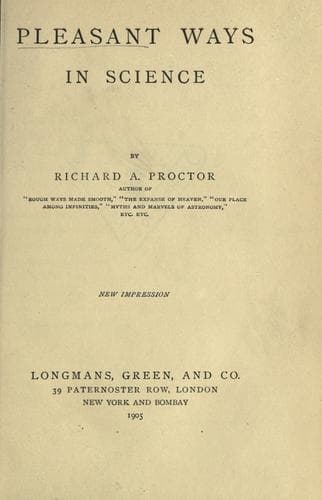
Pleasant Ways in ScienceProctor, Richard A. (Richard Anthony)
Science
Pleasant Ways in Science
Proctor, Richard A. (Richard Anthony)
Science
be expected to be competent adequately to discuss such matters.
Although, however, the phonograph is not an instrument depending, like
the telephone, on the action of electricity (in some form or other),
yet it is related closely enough to the telephone to make the mistake
of the _Telegraphic_ journalist a natural one. At least, the mistake
would be natural enough for any one but a telegraphic specialist; the
more so that Mr. Edison is a telegraphist, and that he has effected
several important and interesting inventions in telegraphic and
electrical science. For instance, in the previous article, pp. 270,
271, I had occasion to describe at some length the principles of his
“Motograph.” I spoke of it as “another form of telephone, surpassing
Gray’s and La Cour’s in some respects as a conveyer of musical
tones, but as yet unable to speak like Bell’s ... in telegraphic
communication.” I proceeded: “Gray’s telephone is limited to about one
octave. Edison’s extends from the deepest bass notes to the highest
notes of the human voice, which, when magnets are employed, are almost
inaudible; but it has yet to learn to speak.”
The phonograph is an instrument which _has_ learned to speak, though
it does not speak at a distance like the telephone or the motograph.
Yet there seems no special reason why it should not combine both
qualities—the power of repeating messages at considerable intervals of
time after they were originally spoken, and the power of transmitting
them to great distances.
I have said that the phonograph is an instrument closely related to the
telephone. If we consider this feature of the instrument attentively,
we shall be led to the clearer recognition of the acoustical principles
on which its properties depend, and also of the nature of some of the
interesting acoustical problems on which light seems likely to be
thrown by means of experiments with this instrument.
In the telephone a stretched membrane, or a diaphragm of very flexible
iron, vibrates when words are uttered in its neighbourhood. When
a stretched membrane is used, with a small piece of iron at the
centre, this small piece of iron, as swayed by the vibrations of the
membrane, causes electrical undulations to be induced in the coils
round the poles of a magnet placed in front of the membrane. These
undulations travel along the wire and pass through the coils of another
instrument of similar construction at the other end of the wire, where,
accordingly, a stretched membrane vibrates precisely as the first had
done. The vibrations of this membrane excite atmospheric vibrations
identical in character with those which fell upon the first membrane
when the words were uttered in its neighbourhood; and therefore the
same words appear to be uttered in the neighbourhood of the second
membrane, however far it may be from the transmitting membrane, so only
that the electrical undulations are effectually transmitted from the
sending to the receiving instrument.
Public-domain text, read in full here on John Shaqi.
Reviews
Reviews
No reviews yet
Be the first to share your thoughts on this work.
Elsewhere in the archive
Join the Discussion
Join the discussion
Sign in to leave a comment or review.
Sign InorCreate an account