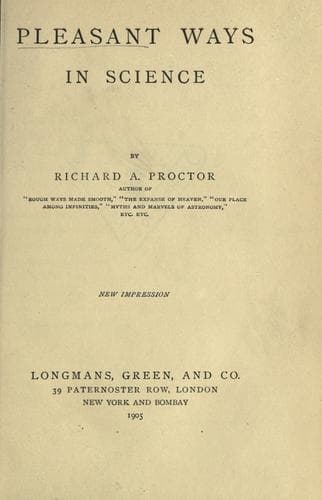
Pleasant Ways in ScienceProctor, Richard A. (Richard Anthony)
Science
Pleasant Ways in Science
Proctor, Richard A. (Richard Anthony)
Science
I have here described what happened in the case of that earlier form
of the telephone in which a stretched membrane of some such substance
as goldbeater’s skin was employed, at the centre of which only was
placed a small piece of iron. For in its bearing on the subject of
the phonograph, this particular form of telephonic diaphragm is
more suggestive than the later form in which very flexible iron was
employed. We see that the vibrations of a small piece of iron at the
centre of a membrane are competent to reproduce all the peculiarities
of the atmospheric waves which fall upon the membrane when words are
uttered in its neighbourhood. This must be regarded, I conceive, as a
remarkable acoustical discovery. Most students of acoustics would have
surmised that to reproduce the motions merely of the central parts
of a stretched diaphragm would be altogether insufficient for the
reproduction of the complicated series of sound-waves corresponding to
the utterance of words. I apprehend that if the problem had originally
been suggested simply as an acoustical one, the idea entertained
would have been this—that though the motions of a diaphragm receiving
vocal sound-waves _might_ be generated artificially in such sort as to
produce the same vocal sounds, yet this could only be done by first
determining what particular points of the diaphragm were centres of
motion, so to speak, and then adopting some mechanical arrangements for
giving to small portions of the membrane at these points the necessary
oscillating motions. It would not, I think, have been supposed that
motions communicated to the centre of the diaphragm would suffice to
make the whole diaphragm vibrate properly in all its different parts.
Let us briefly consider what was before known about the vibrations
of plates, discs, and diaphragms, when particular tones were sounded
in their neighbourhood; and also what was known respecting the
requirements for vocal sounds and speech as distinguished from simple
tones. I need hardly say that I propose only to consider these points
in a general, not in a special, manner.
Public-domain text, read in full here on John Shaqi.
Reviews
Reviews
No reviews yet
Be the first to share your thoughts on this work.
Elsewhere in the archive
Join the Discussion
Join the discussion
Sign in to leave a comment or review.
Sign InorCreate an account