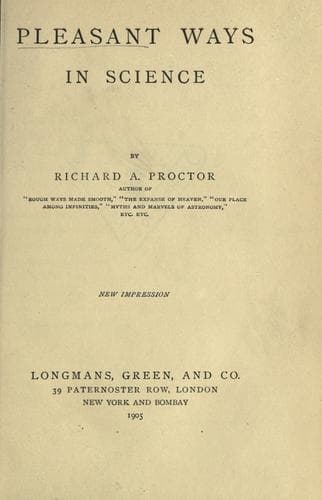
Pleasant Ways in ScienceProctor, Richard A. (Richard Anthony)
Science
Pleasant Ways in Science
Proctor, Richard A. (Richard Anthony)
Science
During the last five or six years a section of the scientific world
has been exercised with the question how far the condition of the
sun’s surface with regard to spots affects our earth’s condition as to
weather, and therefore as to those circumstances which are more or less
dependent on weather. Unfortunately, the question thus raised has not
presented itself alone, but in company with another not so strictly
scientific, in fact, regarded by most men of science as closely related
to personal considerations—the question, namely, whether certain
indicated persons should or should not be commissioned to undertake the
inquiry into the scientific problem. But the scientific question itself
ought not to be less interesting to us because it has been associated,
correctly or not, with the wants and wishes of those who advocate
the endowment of science. I propose here to consider the subject in
its scientific aspect only, and apart from any bias suggested by the
appeals which have been addressed to the administrators of the public
funds.
It is hardly necessary to point out, in the first place, that all
the phenomena of weather are directly referable to the sun as their
governing cause. His rays poured upon our air cause the more important
atmospheric currents directly. Indirectly they cause modifications
of these currents, because where they fall on water or on moist
surfaces they raise aqueous vapour into the air, which, when it
returns to the liquid form as cloud, gives up to the surrounding air
the heat which had originally vaporized the water. In these ways,
directly or indirectly, various degrees of pressure and temperature
are brought about in the atmospheric envelope of the earth, and,
speaking generally, all air currents, from the gentlest zephyr to the
fiercest tornado, are the movements by which the equilibrium of the
air is restored. Like other movements tending to restore equilibrium,
the atmospheric motions are oscillatory. Precisely as when a spring
has been bent one way, it flies not back only, but beyond the mean
position, till it is almost equally bent the other way, so the current
of air which rushes in towards a place of unduly diminished pressure
does more than restore the mean pressure, so that presently a return
current carries off the excess of air thus carried in. We may say,
indeed, that the mean pressure at any place scarcely ever exists, and
when it exists for a time the resulting calm is of short duration.
Just as the usual condition of the sea surface is one of disturbance,
greater or less, so the usual condition of the air at every spot on
the earth’s surface is one of motion not of quiescence. Every movement
of the air, thus almost constantly perturbed, is due directly or
indirectly to the sun.
Public-domain text, read in full here on John Shaqi.
Reviews
Reviews
No reviews yet
Be the first to share your thoughts on this work.
Join the Discussion
Join the discussion
Sign in to leave a comment or review.
Sign InorCreate an account