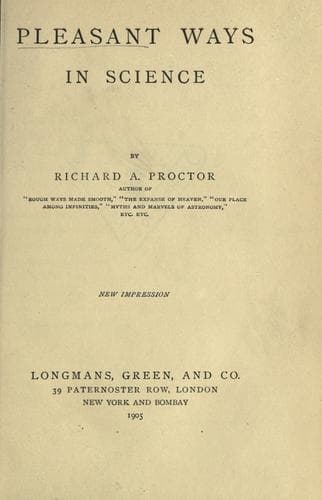
Pleasant Ways in ScienceProctor, Richard A. (Richard Anthony)
Science
Pleasant Ways in Science
Proctor, Richard A. (Richard Anthony)
Science
Probably the arboreal progenitor of man was originally compelled to
abandon his arboreal habits by some slow change in the flora of his
habitat, resulting in the diminution and eventual disappearance of
trees suited for his movements. He would thus be compelled to adopt, at
first, some such course as the chimpanzee—making huts of such branches
and foliage as he could conveniently use for the purpose. The habit
of living in large companies would (as in the case of the chimpanzee)
become before long necessary, especially if the race or races thus
driven from their former abode in the trees were, like the gibbons,
unapt when alone both in attack and in defence. One can imagine how
the use of vocal signals of various kinds would be of service to the
members of these troops, not only in their excursions, but during the
work of erecting huts or defences against their enemies. If in two
generations the silent wild dog acquires, when brought into the company
of domestic dogs, no less than five distinct barking signals, we can
well believe that a race much superior in intelligence, and forced
by necessity to associate in large bodies, would—in many hundreds
of generations, perhaps—acquire a great number of vocal symbols.
These at first would express various emotions, as of affection, fear,
anxiety, sympathy, and so forth. Other signals would be used to
indicate the approach of enemies, or as battle-cries. I can see no
reason why gradually the use of particular vocal signs to indicate
various objects, animate or inanimate, and various actions, should
not follow after a while. And though the possession and use of many,
even of many hundreds, of such signs would be very far from even the
most imperfect of the languages now employed by savage races, one can
perceive the possibility—which is all that at present we can expect
to recognize—that out of such systems of vocal signalling a form of
language might arise, which, undergoing slow and gradual development,
should, in the course of many generations, approach in character
the language of the lowest savage races. That from such a beginning
language should attain its higher and highest developments is not more
wonderful in kind, though much more wonderful, perhaps, in degree,
than that from the first imperfect methods of printing should have
arisen the highest known developments of the typographic art. The
real difficulty lies in conceiving how mere vocal signalling became
developed into what can properly be regarded as spoken language.
Public-domain text, read in full here on John Shaqi.
Reviews
Reviews
No reviews yet
Be the first to share your thoughts on this work.
Elsewhere in the archive
Join the Discussion
Join the discussion
Sign in to leave a comment or review.
Sign InorCreate an account