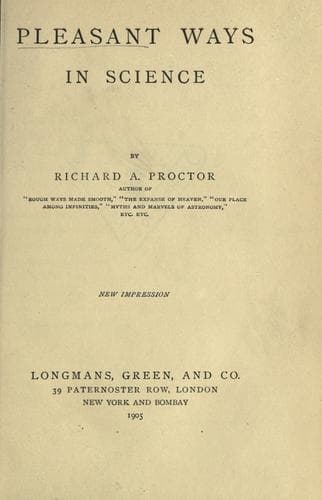
Pleasant Ways in ScienceProctor, Richard A. (Richard Anthony)
Science
Pleasant Ways in Science
Proctor, Richard A. (Richard Anthony)
Science
Of the difficulties related to the origin of, or rather the development
of, man’s moral consciousness, space will not permit me to speak, even
though there were much to be said beyond the admission that these
difficulties have not as yet been overcome. It must be remembered,
however, that races of men still exist whose moral consciousness can
hardly be regarded as very fully developed. Not only so, but, through
a form of reversion to savage types, the highest and most cultivated
races of man bring forth from time to time (as our police reports too
plainly testify) beings utterly savage, brutal, and even (“which is
else”) bestial. Nay, the man is fortunate who has never had occasion
to control innate tendencies to evil which are at least strongly
significant of the origin of our race. To most minds it must be
pleasanter as certainly it seems more reasonable, to believe that the
evil tendencies of our race are manifestations of qualities undergoing
gradual extinction, than to regard them as the consequences of one
past offence, and so to have no reason for trusting in their gradual
eradication hereafter. But, as Darwin says, in the true scientific
spirit, “We are not here concerned with hopes or fears, only with
the truth as far as our reason allows us to discover it. We must
acknowledge that man, with all his noble qualities, with sympathy which
feels for the most debased, with benevolence which extends not only
to other men but to the humblest living creature, with his God-like
intellect which has penetrated into the movements and constitution of
the solar system,—with all these exalted powers, man still bears in
his bodily frame the indelible stamp of his lowly origin.” As it seems
to me, man’s moral nature teaches the same lesson with equal, if not
greater, significance.
_THE USE AND ABUSE OF FOOD._
Public-domain text, read in full here on John Shaqi.
Reviews
Reviews
No reviews yet
Be the first to share your thoughts on this work.
Elsewhere in the archive
Join the Discussion
Join the discussion
Sign in to leave a comment or review.
Sign InorCreate an account