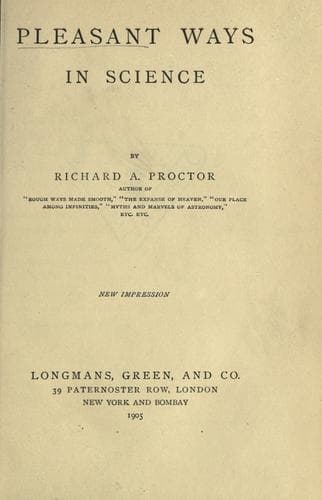
Pleasant Ways in ScienceProctor, Richard A. (Richard Anthony)
Science
Pleasant Ways in Science
Proctor, Richard A. (Richard Anthony)
Science
So far as mere existence is concerned, heat-forming food may be looked
upon as the real fuel on which the lamp of life is sustained. But man,
considered as a working being, cannot exist without _energy-forming_
food. All work, whether of the brain or of the limbs, involves the
exhaustion of nervous and muscular matter; and unless the exhausted
matter be renewed, the work must come to an end. The supply of
heat-giving food may be compared to the supply of fuel for the fire
of a steam-engine. By means of this supply the _fire_ is kept alive;
but if the fire have nothing to work upon, its energies are wasted or
used to the injury of the machine itself. The supply of water, and its
continual use (in the form of steam) in the propulsion of the engine,
are the processes corresponding to the continual exhaustion and renewal
of the muscles and nerves of the human frame. And the comparison may be
carried yet further. We see that in the case of the engine the amount
of smoke, or rather of carbonic acid, thrown out by the blast-pipe is
a measure of the vital energy (so to speak) within the engine; but the
amount of work done by the engine is measured rather by the quantity of
steam which is thrown out, because the elastic force of every particle
of steam has been exerted in the propulsion of the engine before being
thrown out through the blast-pipe. In a manner precisely corresponding
to this, the amount of carbonic acid gas exhaled by a man is a measure
of the rate at which mere existence is proceeding; but the amount of
work, mental or muscular, which the man achieves, is measured by the
amount of used-up brain-material and muscle-material which is daily
thrown off by the body. I shall presently show in what way this amount
is estimated.
In the composition of the muscles there is a material called _fibrine_,
and in the composition of the nerves there is a material called
_albumen_. These are the substances[42] which are exhausted during
mental and bodily labour, and which have to be renewed if we are to
continue working with our head or with our hands. Nay more, life itself
involves work; the heart, the lungs, the liver, each internal organ of
the body, performs its share of work, just as a certain proportion of
the power of a steam-engine is expended in merely moving the machinery
which sets it in action. If the waste of material involved in this form
of work is not compensated by a continual and sufficient supply of
fibrine and albumen the result will be a gradual lowering of all the
powers of the system, until some one or other gives way,—the heart
ceases to beat, or the stomach to digest, or the liver to secrete
bile,—and so death ensues.
Public-domain text, read in full here on John Shaqi.
Reviews
Reviews
No reviews yet
Be the first to share your thoughts on this work.
Elsewhere in the archive
Join the Discussion
Join the discussion
Sign in to leave a comment or review.
Sign InorCreate an account