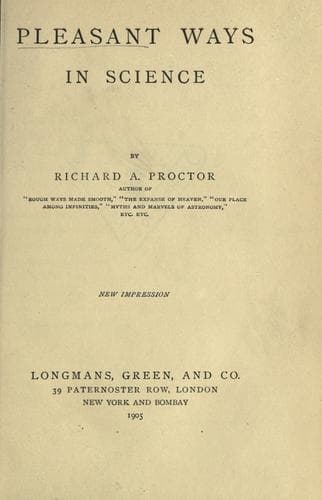
Pleasant Ways in ScienceProctor, Richard A. (Richard Anthony)
Science
Pleasant Ways in Science
Proctor, Richard A. (Richard Anthony)
Science
The fibrine and albumen in the animal frame are derived exclusively
from vegetables. For although we seem to derive a portion of the
supply from animal food, yet the fibrine and albumen thus supplied
have been derived in the beginning from the vegetable kingdom. “It is
the peculiar property of the plant,” says Dr. Lankester, “to be able,
in the minute cells of which it is composed, to convert the carbonic
acid and ammonia which it gets from the atmosphere into fibrine
and albumen, and by easy chemical processes we can separate these
substances from our vegetable food. Wheat, barley, oats, rye, rice, all
contain fibrine, and some of them also albumen. Potatoes, cabbage, and
asparagus contain albumen. It is a well-ascertained fact that those
substances which contain most of these ‘nutritious secretions,’ as they
have been called, support life the longest.” They change little during
the process of digestion, entering the blood in a pure state, and being
directly employed to renew the nervous and muscular matter which has
been used up during work, either mental or muscular. Thus the supply
of these substances is continually being drawn upon. The carbon, which
forms their principal constituent, is converted into carbonic acid;
and the nitrogen, which forms about a sixth part of their substance,
re-appears in the nitrogen of urea, a substance which forms the
principal solid constituent of the matter daily thrown from the system
through the action of the kidneys. Thus the amount of urea which daily
passes from the body affords a measure of the work done during the day.
“This is not,” says Dr. Lankester, “the mere dream of the theorist;
it has been practically demonstrated that increased stress upon the
nervous system, viz., brain work, emotion, or excitement from disease,
increases the quantity of urea and the demand for nitrogenous food. In
the same manner the amount of urea is the representative of the amount
of muscular work done.”
Public-domain text, read in full here on John Shaqi.
Reviews
Reviews
No reviews yet
Be the first to share your thoughts on this work.
Elsewhere in the archive
Join the Discussion
Join the discussion
Sign in to leave a comment or review.
Sign InorCreate an account