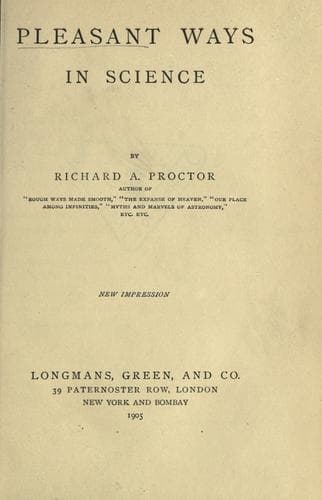
Pleasant Ways in ScienceProctor, Richard A. (Richard Anthony)
Science
Pleasant Ways in Science
Proctor, Richard A. (Richard Anthony)
Science
Men who have to work, quickly find out what they require in the way of
food. The Irishman who, while doing little work, will live contentedly
on potatoes, asks for better flesh-forming food when engaged in heavy
labour. In fact, the employer of the working man, so far from feeling
aggrieved when his men require an improvement in their diet, either as
respects quality or quantity, ought to look on the want as evidence
that they are really working hard in his service, and also that they
have a capacity for continuous work. The man who lives on less than
the average share of flesh-forming food is doing less than an average
amount of work; the man who is unable to eat an average quantity of
flesh-forming food, is _unable_ to do an average amount of work. “‘On
what principle do you discharge your men?’ I once said,” relates Dr.
Lankester, “to a railway contractor. ‘Oh,’ he said, ‘it’s according to
their appetites.’ ‘But,’ I said, ‘how do you judge of that?’ ‘Why,’
he said, ‘I send a clerk round when they are getting their dinners,
and those who can’t eat he marks with a bit of chalk, and we send them
about their business.’”
At a lecture delivered at the Royal Museum of Physics and Natural
History at Florence, by Professor Mantegazza, a few years since, the
Professor dwelt on the insufficient food which Italians are in the
habit of taking, as among the most important causes of the weakness of
the nation. “Italians,” he said, “you should follow as closely as you
can the example of the English in your eating and in your drinking,
in the choice of flesh-meat (in tossing off bumpers of your rich
wines),[43] in the quality of your coffee, your tea, and your tobacco.
I give you this advice, dear countrymen, not only as a medical man, but
also as a patriot. It is quite evident, from the way millions of you
perform the process which you call eating and drinking, that you have
not the most elementary notions of the laws of physiology. You imagine
that you are living. You are barely prolonging existence on maccaroni
and water-melons. You neither know how to eat nor how to drink. You
have no muscular energy; and, therefore, you have no continuous mental
energy. The weakness of the individual, multiplied many millions of
times, results in the collective weakness of the nation. Hence results
insufficient work, and thence insufficient production. Thus the returns
of the tax-collector and the custom-house officer are scanty, and the
national exchequer suffers accordingly.” Nor is all this, strange as it
may sound, the mere gossip of the lecture-room. “The question of good
feeding,” says Dr. Lankester, “is one of national importance. It is
vain to expect either brain or muscles to do efficient work when they
are not provided with the proper material. Neither intellectual nor
physical work can be done without good food.”
Public-domain text, read in full here on John Shaqi.
Reviews
Reviews
No reviews yet
Be the first to share your thoughts on this work.
Elsewhere in the archive
Join the Discussion
Join the discussion
Sign in to leave a comment or review.
Sign InorCreate an account