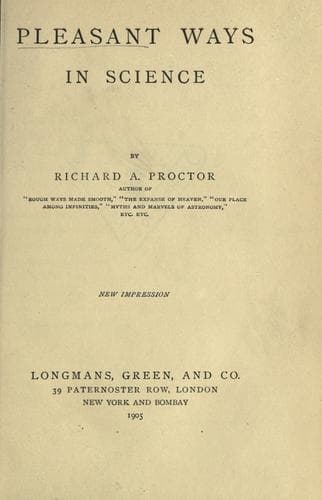
Pleasant Ways in ScienceProctor, Richard A. (Richard Anthony)
Science
Pleasant Ways in Science
Proctor, Richard A. (Richard Anthony)
Science
It has been calculated that the average amount of urea daily formed
in the body of a healthy man is about 470 grains. To supply this
daily consumption of nitrogenous matter, it is necessary that about
four ounces of flesh-forming substance should be consumed daily.
It is important, therefore, to inquire how this substance may be
obtained. The requisite quantity of albuminous and fibrinous matter
“is contained,” says Dr. Lankester, “in a pound of beef; in two pounds
of eggs; in two quarts of milk; in a pound of peas; in five pounds of
rice; in sixteen pounds of potatoes; in two pounds of Indian meal;
in a pound and a half of oatmeal; and in a pound and three-quarters
of flour.” A consideration of this list will show the importance of
attending to the quality as well as the quantity of our food. A man
of ordinary appetite might satisfy his hunger on potatoes or on rice,
without by any means supplying his system with a sufficient amount of
flesh-forming food. On the other hand, if a man were to live on bread
and beef alone, he would load his system with an amount of nitrogenous
food, although not taking what could be considered an excessive amount
of daily nourishment. We see, also, how it is possible to continually
vary the form in which we take the required supply of nitrogenous food,
without varying the amount of that supply from day to day.
The supply itself should of course also vary from day to day as the
amount of daily work may vary. What would be ample for a person
performing a moderate amount of work would be insufficient for one
who underwent daily great bodily or mental exertions, and would be
too much for one who was taking holiday. It would appear, from the
researches of Dr. Haughton, that the amount of urea daily formed in
the body of a healthy man of average weight varies from 400 to 630
grains. Of this weight it appears that 300 grains results from the
action of the internal organs. It would seem, therefore, that the
amount of flesh-forming food indicated in the preceding paragraph may
be diminished in the proportion of 47 to 40 in the case of a person
taking the minimum of exercise—that is, avoiding all movements save
those absolutely necessary for comfort or convenience. On the other
hand, that amount must be increased in the proportion of 74 to 63 in
the case of a person (of average weight) working up to his full powers.
It will be seen at once, therefore, that a hardworking man, whether
labourer or thinker, must make good flesh-forming food constitute a
considerable portion of his diet; otherwise he would require to take an
amount of food which would seriously interfere with his comfort and the
due action of his digestive organs. For instance, if he lived on rice
alone, he would require to ingest nearly seven pounds of food daily; if
on potatoes, he would require upwards of twenty-one pounds; whereas one
pound and a third of meat would suffice to supply the same amount of
flesh-forming food.
Public-domain text, read in full here on John Shaqi.
Reviews
Reviews
No reviews yet
Be the first to share your thoughts on this work.
Elsewhere in the archive
Join the Discussion
Join the discussion
Sign in to leave a comment or review.
Sign InorCreate an account