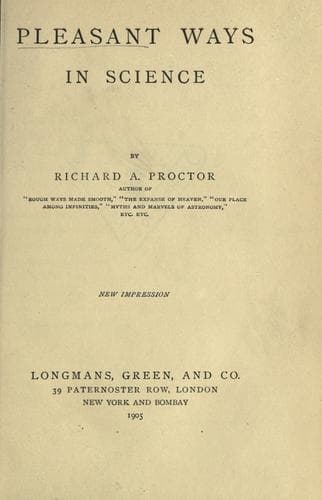
Pleasant Ways in ScienceProctor, Richard A. (Richard Anthony)
Science
Pleasant Ways in Science
Proctor, Richard A. (Richard Anthony)
Science
Of alcoholic liquors it is impossible to speak so favourably. They
are made use of, indeed, almost as extensively as tea or coffee; they
have been made the theme of the poet, and hailed as the emblems of
all that is genial and convivial. Yet there can be little doubt that,
when a balance is struck between the good and evil which have resulted
to man from their use, the latter is found largely to preponderate.
The consideration of these evils belongs, however, rather to the
moralist than to the physiologist. I have here simply to consider
alcoholic liquors as articles of food. There can be little doubt that,
when used with caution and judgment, they afford in certain cases an
important adjunct to those articles which are directly applied to
the reparation of bodily waste. Without absolutely nourishing the
frame, they ultimately lead to this end by encouraging the digestive
processes which result in the assimilation of nutritive articles of
food. But the quantity of alcohol necessary to effect this is far less
than is usually taken even by persons who are termed temperate. It is
also certain that hundreds make use of alcoholic liquors who have no
necessity for them, and who would be better without them. Those who
require them most are men who lead a studious sedentary life; and it
is such men, also, who suffer most from excess in the use of alcoholic
liquors.
It remains that I should make a few remarks on mistakes respecting the
quantity of food.
Some persons fall into the habit of taking an excessive quantity of
food, not from greediness, but from the idea that a large amount of
food is necessary for the maintenance of their strength. They thus
overtax the digestive organs, and not only fail of their purpose, but
weaken instead of strengthening the system. Especially serious is the
mistake often made by persons in delicate health of swallowing—no
other word can be used, for the digestive organs altogether refuse
to respond to the action of the mouth—large quantities of some
concentrated form of food, such as even the strongest stomach could
not deal with in that form. I knew a person who, though suffering
from weakness such as should have suggested the blandest and simplest
forms of food, adopted as a suitable breakfast mutton-chops and
bottled stout, arguing, when remonstrated with, that he required more
support than persons in stronger health. He was simply requiring his
weak digestive organs to accomplish work which would have taxed the
digestive energies of the most stalwart labourer working daily in the
open air for many hours.
Public-domain text, read in full here on John Shaqi.
Reviews
Reviews
No reviews yet
Be the first to share your thoughts on this work.
Elsewhere in the archive
Join the Discussion
Join the discussion
Sign in to leave a comment or review.
Sign InorCreate an account