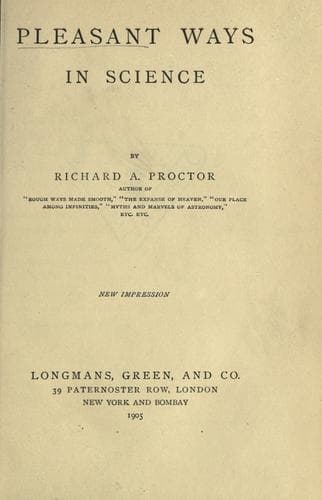
Pleasant Ways in ScienceProctor, Richard A. (Richard Anthony)
Science
Pleasant Ways in Science
Proctor, Richard A. (Richard Anthony)
Science
On the other hand, a too abstemious diet is as erroneous in principle
as a diet in excess of the natural requirements of the system. A
diet which is simply too abstemious is perhaps less dangerous than
persistent abstinence from the use of certain necessary forms of food.
Nature generally prevents us from injuring ourselves by unwisely
diminishing the quantity of food we take; but unfortunately she is not
always equally decided in her admonitions respecting the quality of
our food. A man may be injuring his health through a deficiency in the
amount either of the heat-forming or of the flesh-forming food which he
consumes, and yet know nothing of the origin of the mischief. It may
also be noted that systematic abstinence, either as respects quantity
or quality of food, is much more dangerous than an occasional fast.
Indeed, it is not generally injurious either to abstain for several
days from particular articles or forms of food, or to remain, for
several hours beyond the usual interval between meals, without food of
any sort. On the contrary, benefit often arises from each practice. The
Emperor Aurelian used to attribute the good health he enjoyed to his
habit of abstaining for a whole day, once a month, from food of all
sorts; and many have found the Lenten rules of abstinence beneficial.
As a rule, however, change of diet is a safer measure than periodical
fasting or abstinence from either heat-producing or flesh-forming
food. It must be noticed, in conclusion, that young persons ought not,
without medical advice, to fast or abstain for any length of time from
the more important forms of food, as serious mischief to the digestive
organs frequently follows from either course.
_OZONE._
The singular gas termed ozone has attracted a large amount of attention
from chemists and meteorologists. The vague ideas which were formed as
to its nature when as yet it had been but newly discovered, have given
place gradually to more definite views; and though we cannot be said
to have thoroughly mastered all the difficulties which this strange
element presents, yet we know already much that is interesting and
instructive.
Let us briefly consider the history of ozone.
Nine years after Priestley had discovered oxygen, Van Marum, the
electrician, noticed that when electric sparks are taken through that
gas, a peculiar odour is evolved. Most people know this odour, since
it is always to be recognized in the neighbourhood of an electrical
machine in action. In reality, it indicates the presence of ozone in
the air. But for more than half a century after Van Marum had noticed
it, it was supposed to be the “smell of electricity.”
Public-domain text, read in full here on John Shaqi.
Reviews
Reviews
No reviews yet
Be the first to share your thoughts on this work.
Elsewhere in the archive
Join the Discussion
Join the discussion
Sign in to leave a comment or review.
Sign InorCreate an account