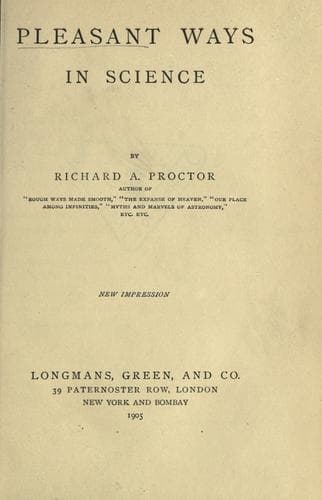
Pleasant Ways in ScienceProctor, Richard A. (Richard Anthony)
Science
Pleasant Ways in Science
Proctor, Richard A. (Richard Anthony)
Science
Now, Dr. Odling, to whom we owe the solution of the perplexing problem
described above, thus interpreted the observed phenomena. A molecule
of oxygen contains two atoms, one of ozone contains three, _and the
oxidizing power of ozone depends on the ease with which it parts with
its third atom of oxygen_. Thus, in the experiment which perplexed
Messrs. Andrews and Tait, the mercury only _seemed_ to absorb the
ozone; in reality it converted the ozone into oxygen by removing
its third atom. And now we see how to interpret such a result as we
considered in our illustrative case. Five cubic inches of oxygen
gave up their atoms, each atom combining with one of the remaining
oxygen doublets, so as to form a set of ozone triplets. Clearly, then,
fifteen cubic inches of oxygen were transformed into ozone. They now
occupied but ten cubic inches; so that the mixture, or ozonized oxygen,
contained eighty-five cubic inches of oxygen and ten of ozone. When the
mercury was introduced, it simply transformed all the ozone triplets
into oxygen doublets, by taking away the odd atom from each. It thus
left ten cubic inches of oxygen, which, with the remaining eighty-five,
constituted the ninety-five cubic inches observed to remain after the
supposed absorption of the ozone.
It follows, of course, that ozone is half as heavy again as oxygen.
But, as Mr. Heaton remarked, “this beautiful hypothesis, although
accounting perfectly for all known facts, was yet but a probability.
One link was lacking in the chain of evidence, and that link M. Soret
has supplied by a happily devised experiment.” Although mercury and
most substances are only capable of converting ozone into oxygen, oil
of turpentine has the power of absorbing ozone in its entirety. Thus,
when the experiment was repeated, with oil of turpentine in place of
the mercury, the ozone was absorbed, and the remaining oxygen, instead
of occupying ninety-five inches, occupied but eighty-five. After
this, no doubt could remain that Dr. Odling’s ingeniously conceived
hypothesis was the correct explanation of Messrs. Andrews and Tait’s
experiment.
We recognize, then, in ozone a sort of concentrated oxygen, with this
peculiar property, that it possesses an extraordinary readiness to
part with its characteristic third atom, and so disappear _as ozone_,
two-thirds of its weight remaining as oxygen.
It is to this peculiarity that ozone owes the properties which render
it so important to our welfare. We are indeed, as yet, in no position
to theorize respecting this element, our knowledge of its very
existence being so recent, and our information respecting its presence
in our atmosphere being of still more recent acquisition.
Public-domain text, read in full here on John Shaqi.
Reviews
Reviews
No reviews yet
Be the first to share your thoughts on this work.
Elsewhere in the archive
Join the Discussion
Join the discussion
Sign in to leave a comment or review.
Sign InorCreate an account