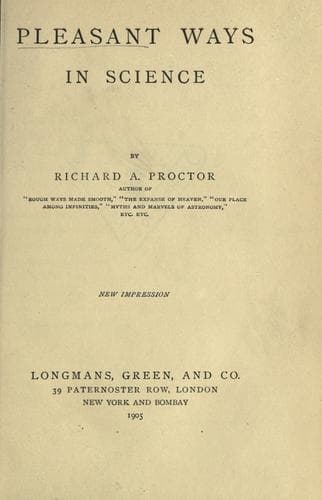
Pleasant Ways in ScienceProctor, Richard A. (Richard Anthony)
Science
Pleasant Ways in Science
Proctor, Richard A. (Richard Anthony)
Science
Suppose, for instance, that we have one hundred cubic inches of oxygen,
and that by any process we reduce it to a combination of oxygen and
ozone occupying ninety-five cubic inches. Now, if the mercury absorbed
the ozone, and we found, say, that there only remained eighty-five
cubic inches of oxygen, we could reason in this way:—Ten cubic inches
were occupied by the ozone before the mercury absorbed it; but these
correspond to fifteen cubic inches of oxygen; hence, ozone must be
denser than oxygen in the proportion of fifteen to ten, or three to
two. And whatever result might have followed, a real absorption of the
ozone by the mercury would have satisfactorily solved the problem.
But the result actually obtained did not admit of interpretation in
this way. The apparent absorption of the ozone by the mercury, that
is, the disappearance of the ozone from the mixture, was accompanied
by _no diminution of volume at all_. In other words, returning to
our illustrative case, after the absorption of the ozone from the
ninety-five cubic inches occupied by the mixture, there still remained
ninety-five cubic inches of oxygen; so that it seemed as though an
evanescent volume of ozone corresponded in weight to five cubic inches
of oxygen. This solution, of course, could not be admitted, since it
made the density of ozone _infinite_.
The explanation of this perplexing experiment is full of interest and
instruction. The following is the account given by Mr. C. W. Heaton
(Professor of Chemistry at Charing Cross Hospital), slightly modified,
however, so that it may be more readily understood.
Modern chemists adopt, as a convenient mode of representing the
phenomena which gases exhibit, the theory that every gas, whether
elementary or compound, consists of minute molecules. They suppose
that these molecules are of equal size, and are separated by equal
intervals so long as the gas remains unchanged in heat and density.
This view serves to account for the features of resemblance presented
by all gases. The features in which gases vary are accounted for by the
theory that the molecules are differently constituted. The molecules
are supposed to be clusters of atoms, and the qualities of a gas are
assumed to depend on the nature and arrangement of these ultimate
atoms. The molecules of some elements consist but of a single atom;
the molecules of others are formed by pairs of atoms; those of others
by triplets; and so on. Again, the molecules of compound gases are
supposed to consist of combinations of different _kinds_ of atoms.
Public-domain text, read in full here on John Shaqi.
Reviews
Reviews
No reviews yet
Be the first to share your thoughts on this work.
Elsewhere in the archive
Join the Discussion
Join the discussion
Sign in to leave a comment or review.
Sign InorCreate an account