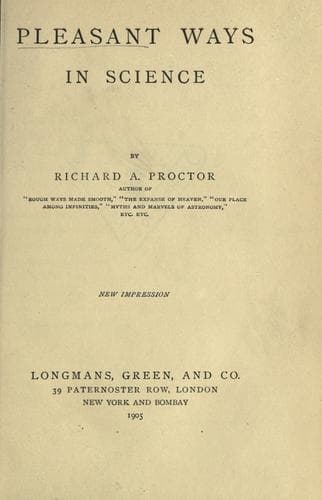
Pleasant Ways in ScienceProctor, Richard A. (Richard Anthony)
Science
Pleasant Ways in Science
Proctor, Richard A. (Richard Anthony)
Science
It will of course be understood that ozone, in thus acting as a
disinfectant, is transformed into oxygen. It parts with its third atom
as in the mercury experiment, and so loses its distinctive peculiarity.
Thus we might be led to anticipate the results which come next to be
considered.
Ozone has certain work to do, and in doing that work is transmuted into
oxygen. It follows, then, that where there has been much work for ozone
to do, there we shall find little ozone left in the air. Hence, in
open spaces where there is little decomposing matter, we should expect
to find more ozone than in towns or cities. This accords with what is
actually observed. And not only is it found that country air contains
more ozone than town air, but it is found that air which has come from
the sea has more ozone than even the country air, while air in the
crowded parts of large cities has no ozone at all, nor has the air of
inhabited rooms.
So far as we have gone, we might be disposed to speak unhesitatingly in
favour of the effects produced by ozone. We see it purifying the air
which would otherwise be loaded by the products of decomposing matter,
we find it present in the sea air and the country air which we know
to be so bracing and health-restoring after a long residence in town,
and we find it absent just in those places which we look upon as most
unhealthy.
Again, we find further evidence of the good effects of ozone in
the fact that cholera and other epidemics never make their dreaded
appearance in the land when the air is well supplied with ozone—or
in what the meteorologists call “the ozone-periods.” And though we
cannot yet explain the circumstance quite satisfactorily, we yet seem
justified in ascribing to the purifying and disinfecting qualities of
ozone our freedom at those times from epidemics to which cleanliness
and good sanitary regulations are notedly inimical.
But there is a reverse side to the picture. And as we described an
experiment illustrating the disinfecting qualities of ozone before
describing the good effects of the element, we shall describe an
experiment illustrating certain less pleasing qualities of ozone,
before discussing the deleterious influences which it seems capable of
exerting.
Dr. Richardson found that when the air of a room was so loaded with
ozone as to be only respirable with difficulty, animals placed in the
room were affected in a very singular manner. “In the first place,”
he says, “all the symptoms of nasal catarrh and of irritation of the
mucous membranes of the nose, the mouth, and the throat were rapidly
induced. Then followed free secretion of saliva and profuse action of
the skin—perspiration. The breathing was greatly quickened, and the
action of the heart increased in proportion.” When the animals were
suffered to remain yet longer within the room, congestion of the lungs
followed, and the disease called by physicians “congestive bronchitis”
was set up.
Public-domain text, read in full here on John Shaqi.
Reviews
Reviews
No reviews yet
Be the first to share your thoughts on this work.
Elsewhere in the archive
Join the Discussion
Join the discussion
Sign in to leave a comment or review.
Sign InorCreate an account