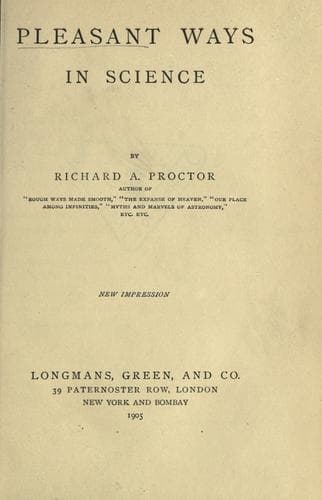
Pleasant Ways in ScienceProctor, Richard A. (Richard Anthony)
Science
Pleasant Ways in Science
Proctor, Richard A. (Richard Anthony)
Science
A very singular circumstance was noticed also as to the effects of
ozone on the different orders of animals. The above-mentioned effects,
and others which accompanied them, the description of which would be
out of place in these pages, were developed more freely in carnivorous
than in herbivorous animals. Rats, for example, were much more easily
influenced by ozone than rabbits were.
The results of Dr. Richardson’s experiments prepare us to hear that
ozone-periods, though characterized by the absence of certain diseases,
bring with them their own forms of disease. Apoplexy, epilepsy,
and other similar diseases seem peculiarly associated with the
ozone-periods, insomuch that eighty per cent. of the deaths occurring
from them take place on days when ozone is present in the air in larger
quantities than usual. Catarrh, influenza, and affections of the
bronchial tubes, also affect the ozone-periods.
We see, then, that we have much yet to learn respecting ozone before
we can pronounce definitively whether it is more to be welcomed or
dreaded. We must wait until the researches which are in progress have
been carried out to their conclusion, and perhaps even then further
modes of inquiry will have to be pursued before we can form a definite
opinion.
_DEW._
There are few phenomena of common occurrence which have proved more
perplexing to philosophers than those which attend the deposition of
dew. Every one is familiar with these phenomena, and in very early
times observant men had noticed them; yet it is but quite recently
that the true theory of dew has been put forward and established.
This theory affords a striking evidence of the value of careful and
systematic observation applied even to the simplest phenomena of nature.
It was observed, in very early times, that dew is only formed on
clear nights, when, therefore, the stars are shining. It was natural,
perhaps, though hardly philosophical, to conclude that dew is directly
shed down upon the earth from the stars; accordingly, we find the
reference of dew to stellar influences among the earliest theories
propounded in explanation of the phenomenon.
A theory somewhat less fanciful, but still depending on supposed
stellar influences, was shortly put forward. It was observed that
dew is only formed when the atmosphere is at a low temperature; or,
more correctly, when the air is at a much lower temperature than has
prevailed during the daytime. Combining this peculiarity with the
former ancient philosophers reasoned in the following manner: Cold
generates dew, and dew appears only when the skies are clear—that is,
when the stars are shining; hence it follows that the stars generate
cold, and thus lead indirectly to the formation of dew. Hence arose
the singular theory, that as the sun pours down heat upon the earth, so
the stars (and also the moon and planets) pour down cold.
Public-domain text, read in full here on John Shaqi.
Reviews
Reviews
No reviews yet
Be the first to share your thoughts on this work.
Elsewhere in the archive
Join the Discussion
Join the discussion
Sign in to leave a comment or review.
Sign InorCreate an account