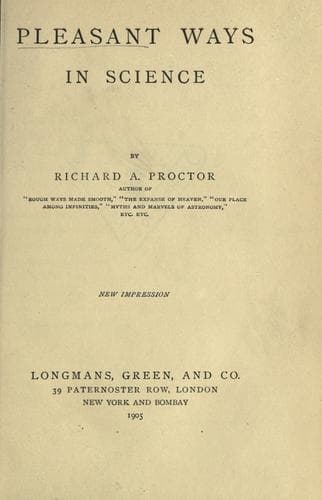
Pleasant Ways in ScienceProctor, Richard A. (Richard Anthony)
Science
Pleasant Ways in Science
Proctor, Richard A. (Richard Anthony)
Science
But although this is the correct view, and though physicists had made
a noteworthy advance in getting rid of erroneous notions, yet a theory
of dew still remained to be formed; for it was not yet shown how the
cold, which causes the deposition of dew, is itself occasioned. The
remarkable effects of a clear sky and serene weather in encouraging the
formation of dew, were also still unaccounted for. On the explanation
of these and similar points, the chief interest of the subject depends.
Science owes the elucidation of these difficulties to Dr. Wells, a
London physician, who studied the subject of dew in the commencement
of the present century. His observations were made in a garden three
miles from Blackfriars Bridge.
Wells exposed little bundles of wool, weighing, when dry, ten grains
each, and determined by their increase in weight the amount of moisture
which had been deposited upon them. At first, he confined himself to
comparing the amount of moisture collected on different nights. He
found that although it was an invariable rule that cloudy nights were
unfavourable to the deposition of dew, yet that on some of the very
clearest and most serene nights, less dew was collected than on other
occasions. Hence it became evident that mere clearness was not the only
circumstance which favoured the deposition of dew. In making these
experiments, he was struck by results which appeared to be anomalous.
He soon found that these anomalies were caused by any obstructions
which hid the heavens from his wool-packs: such obstructions hindered
the deposition of dew. He tried a crucial experiment. Having placed
a board on four props, he laid a piece of wool _on_ the board,
and another _under_ it. During a clear night, he found that the
difference in the amount of dew deposited on the two pieces of wool
was remarkable: the upper one gained fourteen grains in weight, the
lower one gained only four grains. He made a little roof over one piece
of wool, with a sheet of pasteboard; and the increase of weight was
reduced to two grains, while a piece of wool outside the roof gained no
less than sixteen grains in weight.
Leaving these singular results unexplained for a while, Dr. Wells
next proceeded to test the temperature near his wool-packs. He found
that where dew is most copiously produced, there the temperature is
lowest. Now, since it is quite clear that the deposition of dew was not
the cause of the increased cold—for the condensation of vapour is a
process _producing heat_—it became quite clear that the formation of
dew is dependent on and proportional to the loss of heat.
Public-domain text, read in full here on John Shaqi.
Reviews
Reviews
No reviews yet
Be the first to share your thoughts on this work.
Elsewhere in the archive
Join the Discussion
Join the discussion
Sign in to leave a comment or review.
Sign InorCreate an account