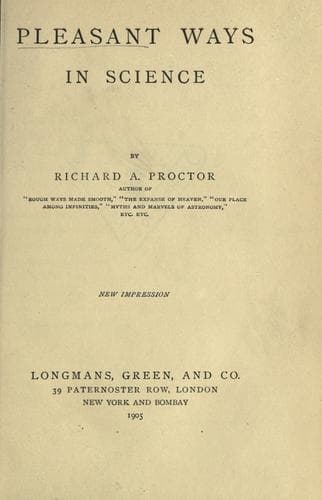
Pleasant Ways in ScienceProctor, Richard A. (Richard Anthony)
Science
Pleasant Ways in Science
Proctor, Richard A. (Richard Anthony)
Science
And now Wells was approaching the solution of the problem he had set
himself; for it followed from his observations, that such obstructions
as the propped board and the pasteboard roof _kept in the heat_. It
followed also, from the observed effects of clear skies, that clouds
_keep in the heat_. Now, what sort of heat is that which is prevented
from escaping by the interference of screens, whether material or
vaporous? There are three processes by which heat is transmitted from
one body to another,—these are, conduction, convection, and radiation.
The first is the process by which objects in contact communicate
their heat to each other, or by which the heat in one part of a body
is gradually transmitted to another part. The second is the process
by which heat is carried from one place to another by the absolute
transmission of heated matter. The third is that process by which heat
is spread out in all directions, in the same manner as light. A little
consideration will show that the last process is that with which we
are alone concerned; and this important result flows from Dr. Wells’
experiments, that _the rate of the deposition of dew depends on the
rate at which bodies part with their heat by radiation_. If the process
of radiation is checked, dew is less copiously deposited, and _vice
versâ_.
When we consider the case of heat accompanied by light, we understand
readily enough that a screen may interfere with the emission of
radiant heat. We use a fire-screen, for instance, with the object of
producing just such an interference. But we are apt to forget that
what is true of luminous heat is true also of that heat which every
substance possesses. In fact, we do not meet with many instances in
which the effect of screens in preventing the loss of obscure heat is
very noteworthy. There are some, as the warmth of a green-house at
night, and so on; but they pass unnoticed, or are misunderstood. It
was in this way that the explanation of dew-phenomena had been so long
delayed. The very law on which it is founded had been _practically_
applied, while its meaning had not been recognized. “I had often
in the pride of half-knowledge,” says Wells, “smiled at the means
frequently employed by gardeners to protect tender plants from cold,
as it appeared to me impossible that a thin mat, or any such flimsy
substance, could prevent them from attaining the temperature of the
atmosphere, by which alone I thought them liable to be injured. But
when I had seen that bodies on the surface of the earth become, during
a still and serene night, colder than the atmosphere, by radiating
their heat to the heavens, I perceived immediately a just reason for
the practice which I had before deemed useless.”
Public-domain text, read in full here on John Shaqi.
Reviews
Reviews
No reviews yet
Be the first to share your thoughts on this work.
Elsewhere in the archive
Join the Discussion
Join the discussion
Sign in to leave a comment or review.
Sign InorCreate an account