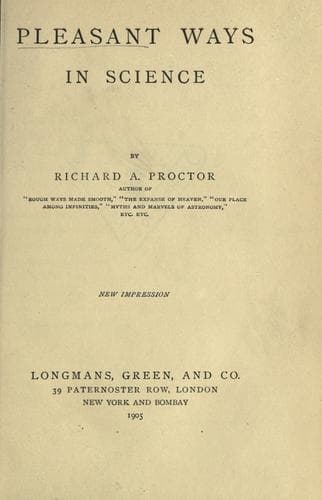
Pleasant Ways in ScienceProctor, Richard A. (Richard Anthony)
Science
Pleasant Ways in Science
Proctor, Richard A. (Richard Anthony)
Science
Even small rivers, when greatly swollen by rain, exhibit great energy
in removing heavy masses. Thus Lyell mentions that in August, 1827, the
College, a small river which flows down a slight declivity from the
eastern watershed of the Cheviot Hills, carried down several thousand
tons’ weight of gravel and sand to the plain of the Till. This little
river also carried away a bridge then in process of building, “some of
the arch stones of which, weighing from half to three-quarters of a ton
each, were propelled two miles down the rivulet.” “On the same occasion
the current tore away from the abutment of a mill-dam a large block
of greenstone porphyry, weighing nearly two tons, and transported it
to a distance of nearly a quarter of a mile. Instances are related as
occurring repeatedly, in which from 1000 to 3000 tons of gravel are in
like manner removed by this streamlet to still greater distances in one
day.”
It may appear, however, to the reader that we have in such instances
as these the illustration of destructive agencies which are of their
very nature limited within very narrow areas. The torrent, or even
the river, may wear out its bed or widen it, but nevertheless can
hardly be regarded as modifying the aspect of the region through which
it flows. Even in this respect, however, the destructive action of
water is not nearly so limited as it might appear to be. Taking a few
centuries or a few thousand years, no doubt, we can attribute to the
action of rivers, whether in ordinary flow or in flood, little power
of modifying the region which they drain. But taking that wider survey
(in time) of fluviatile work which modern science requires, dealing
with this form of aqueous energy as we deal with the earth’s vulcanian
energies, we perceive that the effects of river action in the course of
long periods of time are not limited to the course which at any given
time a river may pursue. In carrying down material along its course
to the sea, a river is not merely wearing down its own bed, but is so
changing it that in the course of time it will become unfit to drain
the region through which it flows. Its bottom must of necessity become
less inclined. Now although it will then be lower than at present,
and therefore be then even more than now the place to which the water
falling upon the region traversed by the river will naturally tend,
it will no longer carry off that water with sufficient velocity.
Three consequences will follow from this state of things. In the
first place there will be great destruction in the surrounding region
through floods because of inadequate outflow; in the second place, the
overflowing waters will in the course of time find new channels, or in
other words new rivers will be formed in this region; thirdly, owing to
the constant presence of large quantities of water in the depressed bed
of the old river, the banks on either side will suffer, great landslips
occurring and choking up its now useless channel.
Public-domain text, read in full here on John Shaqi.
Reviews
Reviews
No reviews yet
Be the first to share your thoughts on this work.
Elsewhere in the archive
Join the Discussion
Join the discussion
Sign in to leave a comment or review.
Sign InorCreate an account