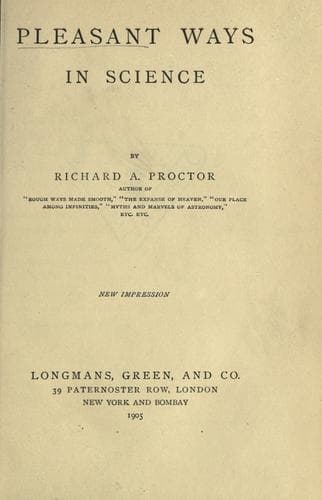
Pleasant Ways in ScienceProctor, Richard A. (Richard Anthony)
Science
Pleasant Ways in Science
Proctor, Richard A. (Richard Anthony)
Science
Several rivers are
undergoing these changes at the present time, and others, which are
manifestly unfit for the work of draining the region through which they
flow (a circumstance attested by the occurrence of floods in every wet
season), must before long be modified in a similar way.
We are thus led to the consideration of the second form in which
the destructive action of inland waters, or we may truly say, the
destructive action of _rain_, is manifested,—viz., in landslips.
These, of course, are also caused not unfrequently by vulcanian action,
but equally of course landslips so caused do not belong to our present
subject. Landslips caused directly or indirectly by rain, are often
quite as extensive as those occasioned by vulcanian energy, and they
are a great deal more common. We may cite as a remarkable instance
a landslip of nearly half a mile in breadth, now in progress, in a
district of the city of Bath called Hedgmead, which forms a portion
of the slope of Beacon Hill. It is attributed to the action of a
subterranean stream on a bed of gravel, the continued washing away of
which causes the shifting; but the heavy rains of 1876–77 caused the
landslip to become much more marked.
Besides slow landslips, however, rain not unfrequently causes great
masses of earth to be precipitated suddenly, and where such masses fall
into the bed of a river, local deluges of great extent and of the most
destructive character often follow. The following instances, cited in
an abridged form from the pages of Lyell’s “Principles of Geology,”
attest the terrible nature of catastrophes such as these.
Public-domain text, read in full here on John Shaqi.
Reviews
Reviews
No reviews yet
Be the first to share your thoughts on this work.
Elsewhere in the archive
Join the Discussion
Join the discussion
Sign in to leave a comment or review.
Sign InorCreate an account