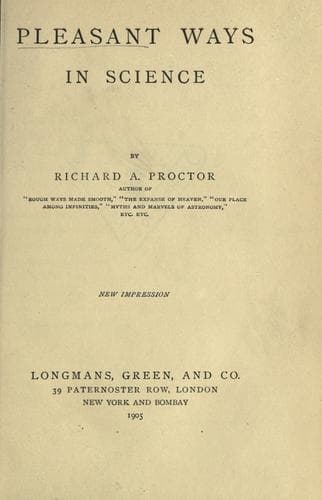
Pleasant Ways in ScienceProctor, Richard A. (Richard Anthony)
Science
Pleasant Ways in Science
Proctor, Richard A. (Richard Anthony)
Science
It will readily be understood that when destruction such as this
follows from landslips along the borders of insignificant rivers,
those occurring on the banks of the mighty rivers which drain whole
continents are still more terrible. The following account from the pen
of Mr. Bates the naturalist, indicates the nature of the landslips
which occur on the banks of the Amazon. “I was awoke before sunrise,
one morning,” he says, “by an unusual sound resembling the roar of
artillery; the noise came from a considerable distance, one crash
succeeding another. I supposed it to be an earthquake, for, although
the night was breathlessly calm, the broad river was much agitated,
and the vessel rolled heavily. Soon afterwards another loud explosion
took place, followed by others which lasted for an hour till the day
dawned, and we then saw the work of destruction going forward on the
other side of the river, about three miles off. Large masses of forest,
including trees of colossal size, probably 200 feet in height, were
rocking to and fro, and falling headlong one after another into the
water. After each avalanche the wave which it caused returned on the
crumbly bank with tremendous force, and caused the fall of other masses
by undermining. The line of coast over which the landslip extended was
a mile or two in length; the end of it, however, was hid from our view
by an intervening island. It was a grand sight; each downfall created
a cloud of spray; the concussion in one place causing other masses
to give way a long distance from it, and thus the crashes continued,
swaying to and fro, with little prospect of termination. When we glided
out of sight two hours after sunrise the destruction was still going
on.”
We might consider here the action of glaciers in gradually grinding
down the mountain slopes, the destructive action of avalanches, and a
number of other forms in which snow and ice break down by slow degrees
the upraised portions of the earth. For in reality all these forms of
destructive action take their origin in the same process whence running
waters and heavy rainfalls derive their power. All these destructive
agencies are derived from the vapour of water in the air. But it seems
better to limit the reader’s attention in this place to the action of
water in the liquid form; and therefore we proceed to consider the
other ways in which rain wears down the land.
Hitherto we have considered effects which are produced chiefly along
the courses of rivers, or in their neighbourhood. But heavy rainfall
acts, and perhaps in the long run as effectively (when we remember the
far wider region affected) over wide tracts of nearly level ground, as
along the banks of torrents and rivers.
Public-domain text, read in full here on John Shaqi.
Reviews
Reviews
No reviews yet
Be the first to share your thoughts on this work.
Elsewhere in the archive
Join the Discussion
Join the discussion
Sign in to leave a comment or review.
Sign InorCreate an account