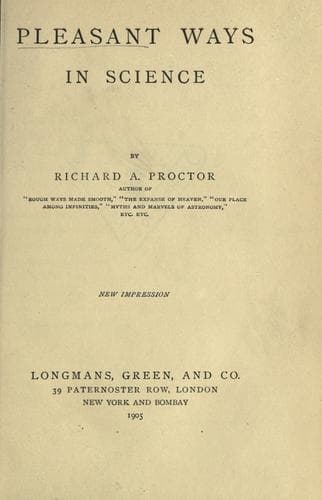
Pleasant Ways in ScienceProctor, Richard A. (Richard Anthony)
Science
Pleasant Ways in Science
Proctor, Richard A. (Richard Anthony)
Science
Two dry seasons in the White Mountains of New Hampshire were followed
by heavy rains on August 28, 1826. From the steep and lofty slopes
of the River Saco great masses of rock and stone were detached, and
descending carried along with them “in one promiscuous and frightful
ruin, forests, shrubs, and the earth which sustained them.” “Although
there are numerous indications on the steep sides of these hills of
former slides of the same kind, yet no tradition had been handed down
of any similar catastrophe within the memory of man, and the growth of
the forest on the very spots now devastated clearly showed that for a
long interval nothing similar had occurred. One of these moving masses
was afterwards found to have slid three miles, with an average breadth
of a quarter of a mile.” At the base of the vast chasms formed by these
natural excavations, a confused mass of ruins was seen, consisting of
transported earth, gravel, rocks, and trees. Forests were prostrated
with as much ease as if they had been mere fields of grain; if they
resisted for a while, “the torrent of mud and rock accumulated behind
till it gathered sufficient force to burst the temporary barrier.”
“The valleys of the Amonoosuck and Saco presented, for many miles, an
uninterrupted scene of desolation, all the bridges being carried away,
as well as those over the tributary streams. In some places the road
was excavated to the depth of from fifteen to twenty feet; in others
it was covered with earth, rocks, and trees to as great a height.
The water flowed for many weeks after the flood, as densely charged
with earth as it could be without being changed into mud, and marks
were seen in various localities of its having risen on either side of
the valley to more than twenty-five feet above the ordinary level.”
But perhaps the most remarkable evidence of the tremendous nature
of this cataclysm is to be found in Lyell’s statements respecting
the condition of the region nineteen years later. “I found the signs
of devastation still very striking,” he says; “I also particularly
remarked that the surface of the bare granite rocks had been smoothed
by the passage over them of so much mud and stone.” Professor Hubbard
mentions in _Silliman’s Journal_ that “in 1838 the deep channels worn
by the avalanches of mud and stone, and the immense heaps of boulders
and blocks of granite in the river channel, still formed a picturesque
feature in the scenery.”
Public-domain text, read in full here on John Shaqi.
Reviews
Reviews
No reviews yet
Be the first to share your thoughts on this work.
Elsewhere in the archive
Join the Discussion
Join the discussion
Sign in to leave a comment or review.
Sign InorCreate an account