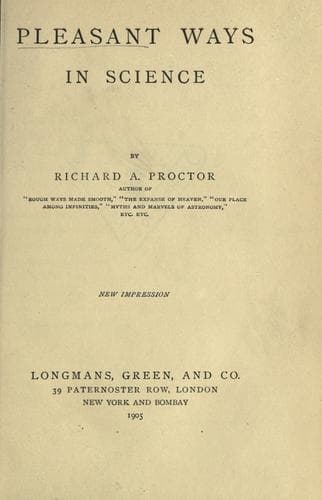
Pleasant Ways in ScienceProctor, Richard A. (Richard Anthony)
Science
Pleasant Ways in Science
Proctor, Richard A. (Richard Anthony)
Science
We have mentioned the formation of dust, and the action of wind upon
it, as a cause tending to level the surface of the land. It may appear
to many that this cause is too insignificant to be noticed among those
which modify the earth’s surface. In reality, however, owing to its
continuous action, and to its always acting (in the main) in one
direction, this cause is much more important than might be supposed.
We overlook its action as actually going on around us, because in a
few years, or in a few generations, it produces no change that can be
readily noticed. But in long periods of time it changes very markedly
the level of lower lands, and that too even in cities, where means
exist for removing the accumulations of dust which are continually
collecting on the surface of the earth. We know that the remains of
old Roman roads, walls, houses, and so forth, in this country, are
found, not at the present level of the surface, but several feet—in
some cases many yards—below this level. The same holds elsewhere,
under the same conditions—that is, where we know quite certainly
that the substances thus found underground were originally on the
surface, and that there has been neither any disturbance causing them
to be engulfed, nor any deposition of scoriæ, volcanic dust, or other
products of subterranean disturbance. We cannot hesitate to regard this
burying of old buildings as due to the continual deposition of dust,
which eventually becomes compacted into solid earth. We know, moreover,
that the formation of dust is in the main due to rain converting the
surface layers of the earth into mud, which on drying requires but the
frictional action of heavy winds to rise in clouds of dust. In some
soils this process goes on more rapidly than in others, as every one
who has travelled much afoot is aware. There are parts of England, for
instance, where, even in the driest summer, the daily deposition of
dust on dry and breezy days is but slight, others where in such weather
a dust layer at least a quarter of an inch in thickness is deposited
in the course of a day. If we assumed, which would scarcely seem an
exaggerated estimate, that in the course of a single year a layer of
dust averaging an inch in thickness is deposited over the lower levels
of the surface of the land, we should find that the average depth of
the layer formed in the last thousand years would amount to no less
than eighty-three feet. Of course in inhabited places the deposition
of dust is checked, though not so much as most persons imagine. There
is not probably in this country a single building five hundred years
old, originally built at a moderately low level, the position of whose
foundation does not attest the constant gathering of matter upon the
surface. The actual amount by which the lower levels are raised and
the higher levels diminished in the course of a thousand years may be
very much less, but that it must amount to many feet can scarcely be
questioned.
Public-domain text, read in full here on John Shaqi.
Reviews
Reviews
No reviews yet
Be the first to share your thoughts on this work.
Elsewhere in the archive
Join the Discussion
Join the discussion
Sign in to leave a comment or review.
Sign InorCreate an account