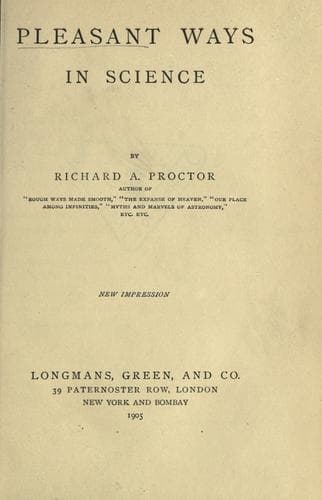
Pleasant Ways in ScienceProctor, Richard A. (Richard Anthony)
Science
Pleasant Ways in Science
Proctor, Richard A. (Richard Anthony)
Science
And as in considering the action of rain falling over a wide range of
country, we have to distinguish between the slow but steady action
of ordinary rains and the occasional violent action of great storms
of rain, so in considering the effects of drought following after
rain which has well saturated the land we have to distinguish between
ordinarily dusty times and occasions when in a very short time, owing
to the intensity of the heat and the violence of the wind large
quantities of dust are spread over a wide area. Darwin thus describes
the effect of such exceptional drought, as experienced in the years
1827–1832 in Buenos Ayres:—“So little rain fell that the vegetation,
even to the thistles, failed; the brooks were dried up, and the
whole country assumed the appearance of a dusty high road. This was
especially the case in the northern part of the province of Buenos
Ayres, and the southern part of Santa Fé.” He describes the loss of
life caused by the want of water, and many remarkable circumstances of
the drought which do not here specially concern us. He then goes on to
speak of the dust which gathered over the open country. “Sir Woodbine
Parish,” he says, “informed me of a very curious source of dispute.
The ground being so long dry, such quantities of dust were blown about
that in this open country the landmarks became obliterated, and people
could not tell the limits of their estates.” The dust thus scattered
over the land, whether left or removed, necessarily formed part of the
solid material brought from higher to lower levels, indirectly (in
this case) through the action of rain; for a drought can only convert
into friable matter earth which has before been thoroughly soaked. But
the action of rain, which had originally led to the formation of these
enormous masses of dust, presently took part in carrying the dust in
the form of mud to yet lower levels. “Subsequently to the drought of
1827 to 1832,” proceeds Darwin, “a very rainy season followed, which
caused great floods. Hence it is almost certain that some thousands
of the skeletons” (of creatures whose deaths he had described before)
“were buried by the deposits of the very next year. What could be the
opinion of a geologist, viewing such an enormous collection of bones,
of all kinds of animals and of all ages, thus embedded in one thick
earthy mass? Would he not attribute it to a flood having swept over the
surface of the land, rather than to the common order of things?” In
fact, a single great drought, followed by a very rainy season, must in
this instance, which was however altogether exceptional, have produced
a layer or stratum such as geologists would ordinarily regard as the
work of a much longer time and much more potent disturbing causes.
Public-domain text, read in full here on John Shaqi.
Reviews
Reviews
No reviews yet
Be the first to share your thoughts on this work.
Elsewhere in the archive
Join the Discussion
Join the discussion
Sign in to leave a comment or review.
Sign InorCreate an account