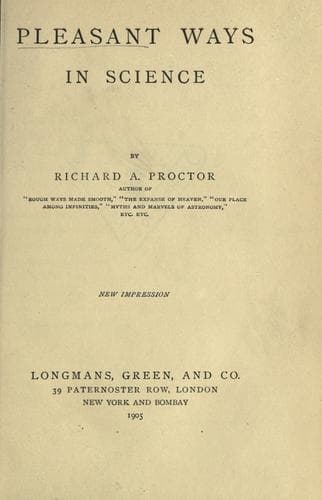
Pleasant Ways in ScienceProctor, Richard A. (Richard Anthony)
Science
Pleasant Ways in Science
Proctor, Richard A. (Richard Anthony)
Science
equally unlikely the idea that peculiarities affecting limited regions
of the sun’s surface should affect appreciably the general condition
of the earth. If a somewhat homely comparison may be permitted, we
can well understand how a piece of meat roasting before a fire may
receive a greater or less supply of heat on the whole as the fire
undergoes slight local changes (very slight indeed they must be, that
the illustration may be accurate); but it would be extremely surprising
if, in consequence of such slight changes in the fire, the roasting of
particular portions of the joint were markedly accelerated or delayed,
or affected in any other special manner.
But of course all such considerations as to antecedent probabilities
must give way before the actual evidence of observed facts. Utterly
inconsistent with all that is yet known of the sun’s physical action,
as it may seem, on _à priori_ grounds, to suppose that spots, currents,
or other local disturbances of the sun’s surface could produce any but
general effects on the earth as a whole, yet if we shall find that
particular effects are produced in special regions of the earth’s
surface in cycles unmistakably synchronizing with the solar-spot-cycle,
we must accept the fact, whether we can explain it or not. Only let it
be remembered at the outset that the earth is a large place, and the
variations of wind and calm, rain and drought, are many and various in
different regions. Whatever place we select for examining the rainfall,
for example, we are likely to find, in running over the records of the
last thirty years or so, some seemingly oscillatory changes; in the
records of the winds, again, we are likely to find other seemingly
oscillatory changes; if none of these records provide anything which
seems in any way to correspond with the solar spot-cycle, we may
perchance find some such cycle in the relative rainfall of particular
months, or in the varying wetness or dryness of particular winds, and
so forth. Or, if we utterly fail to find any such relation in one
place we may find it in another, or not improbably in half-a-dozen
places among the hundreds which are available for the search. If we
are content with imperfect correspondence between some meteorological
process or another and the solar-spot cycle, we shall be exceedingly
unfortunate indeed if we fail to find a score of illustrative
instances. And if we only record these, without noticing any of the
cases where we fail to find any association whatever—in other words,
as Bacon puts it, if “we note when we hit and never note when we
miss,” we shall be able to make what will seem a very strong case
indeed. But this is not exactly the scientific method in such cases.
By following such a course, indeed, we might prove almost anything. If
we take, for instance, a pack of cards, and regard the cards in order
as corresponding to the years 1825 to 1877, and note their colours as
Public-domain text, read in full here on John Shaqi.
Reviews
Reviews
No reviews yet
Be the first to share your thoughts on this work.
Join the Discussion
Join the discussion
Sign in to leave a comment or review.
Sign InorCreate an account