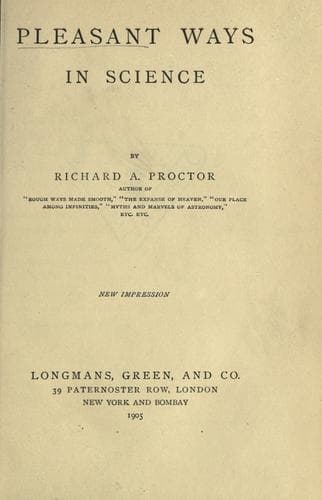
Pleasant Ways in ScienceProctor, Richard A. (Richard Anthony)
Science
Pleasant Ways in Science
Proctor, Richard A. (Richard Anthony)
Science
The most promising result of solar research since Kirchhoff in 1859
interpreted the dark lines of the sun’s spectrum has recently been
announced from America. Interesting in itself, the discovery just made
is doubly interesting in what it seems to promise in the future. Just
as Kirchhoff’s great discovery, that a certain double dark line in the
solar spectrum is due to the vapour of sodium in the sun’s atmosphere,
was but the first of a long series of results which the spectroscopic
analysis of the sun was to reveal, so the discovery just announced that
a certain important gas—the oxygen present in our air and the chief
chemical constituent of water—shows its presence in the sun by bright
lines instead of dark, will in all probability turn out to be but the
firstfruits of a new method of examining the solar spectrum. As its
author, Dr. Henry Draper, of New York, remarks, further investigation
in the direction he has pursued will lead to the discovery of other
elements in the sun, but it was not “proper to conceal, for the sake
of personal advantage, the principle on which such researches are to
be conducted.” It may well happen, though I anticipate otherwise, that
by thus at once describing his method of observation, Dr. Draper may
enable others to add to the list of known solar elements some which
yet remain to be detected; but if Dr. Draper should thus have added but
one element to that list, he will ever be regarded as the physicist
to whose acumen the method was due by which all were detected, and to
whom, therefore, the chief credit of their discovery must certainly be
attributed.
I propose briefly to consider the circumstances which preceded the
great discovery which it is now my pleasing duty to describe, in order
that the reader may the more readily follow the remarks by which I
shall endeavour to indicate some of the results which seem to follow
from the discovery, as well as the line along which, in my opinion, the
new method may most hopefully be followed.
Public-domain text, read in full here on John Shaqi.
Reviews
Reviews
No reviews yet
Be the first to share your thoughts on this work.
Join the Discussion
Join the discussion
Sign in to leave a comment or review.
Sign InorCreate an account