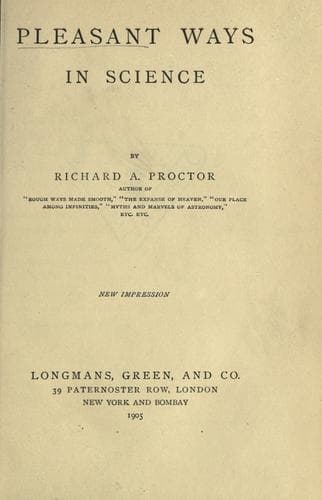
Pleasant Ways in ScienceProctor, Richard A. (Richard Anthony)
Science
Pleasant Ways in Science
Proctor, Richard A. (Richard Anthony)
Science
The heliometer, then, is a telescope whose object-glass (that is,
the large glass at the end towards the object observed) is divided
into two halves along a diameter. When these two halves are exactly
together—that is, in the position they had before the glass was
divided—of course they show any object to which they may be directed
precisely as they would have done before the glass was cut. But if,
without separating the straight edges of the two semicircular glasses,
one be made to slide along the other, the images formed by the two
no longer coincide.[9] Thus, if we are looking at the sun we see
two overlapping discs, and by continuing to turn the screw or other
mechanism which carries our half-circular glass past the other, the
disc-images of the sun may be brought entirely clear of each other.
Then we have two suns in the same field of view, seemingly in contact,
or nearly so. Now, if we have some means of determining how far the
movable half-glass has been carried past the other to bring the two
discs into apparently exact contact, we have, in point of fact, a
measure of the sun’s apparent diameter. We can improve this estimate by
carrying back the movable glass till the images coincide again, then
further back till they separate the other way and finally are brought
into contact on that side. The entire range, from contact on one side
to contact on the other side, gives twice the entire angular span of
the sun’s diameter; and the half of this is more likely to be the true
measure of the diameter, than the range from coincident images to
contact either way, simply because instrumental errors are likely to be
more evenly distributed over the double motion than over the movement
on either side of the central position. The heliometer derived its
name—which signifies sun-measurer—from this particular application of
the instrument.
It is easily seen how the heliometer was made available in determining
the position of Venus at any instant during transit. The observer
could note what displacement of the two half-glasses was necessary to
bring the black disc of Venus on one image of the sun to the edge of
the other image, first touching on the inside and then on the outside.
Then, reversing the motion, he could carry her disc to the opposite
edge of the other image of the sun, first touching on the inside and
then on the outside. Lord Lindsay’s private expedition—one of the
most munificent and also one of the most laborious contributions to
astronomy ever made—was the only English expedition which employed
the heliometer, none of our public observatories possessing such an
instrument, and official astronomers being unwilling to ask Government
to provide instruments so costly. The Germans, however, and the
Russians employed the heliometer very effectively.
Next in order of proximity, for the employment of the direct surveying
method, is the planet Mars when he comes into opposition (or on the
same line as the earth and sun) in the order
Public-domain text, read in full here on John Shaqi.
Reviews
Reviews
No reviews yet
Be the first to share your thoughts on this work.
Join the Discussion
Join the discussion
Sign in to leave a comment or review.
Sign InorCreate an account