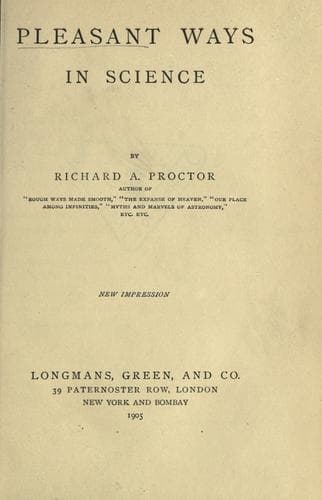
Pleasant Ways in ScienceProctor, Richard A. (Richard Anthony)
Science
Pleasant Ways in Science
Proctor, Richard A. (Richard Anthony)
Science
Thus was it shown that in the atmosphere of the sun there is the
glowing vapour of the familiar metal, iron; and in like manner other
metals, and one element (hydrogen) which is not ordinarily regarded as
a metal, were shown to be present in the sun’s atmosphere. In saying
that they are present in the sun’s atmosphere, I am, in point of fact,
saying that they are present in the sun; for the solar atmosphere is,
in fact, the outer part of the sun himself, since a very large part,
if not by far the greater part, of the sun’s mass must be vaporous.
But no other elements, except the metals iron, sodium, barium,
calcium, magnesium, aluminium, manganese, chromium, cobalt, nickel,
zinc, copper, and titanium, and the element hydrogen, were shown
to be present in the sun, by this method of observing directly the
solar dark lines. In passing, I may note that there are reasons for
regarding hydrogen as a metallic element, strange though the idea may
seem to those who regard hardness, brightness, malleability, ductility,
plasticity, and the like, as the characteristic properties of metals,
and necessarily fail to comprehend how a gas far rarer, under the
same conditions, than the air we breathe, and which cannot possibly
be malleable, ductile, or the like, can conceivably be regarded as a
metal. But there is in reality no necessary connection between any one
of the above properties and the metallic nature; many of the fifty-five
metals are wanting in all of these properties; nor is there any reason
why, as we have in mercury a metal which at ordinary temperatures is a
liquid, so we might have in hydrogen a metal which, at all obtainable
temperatures, and under all obtainable conditions of pressure, is
gaseous. It was shown by the late Professor Graham (aided in his
researches most effectively by Dr. Chandler Roberts) that hydrogen will
enter into such combination with the metal palladium that it may be
regarded as forming, for the time, with the palladium, an alloy; and
as alloys can only be regarded as compounds of two or more metals, the
inference is that hydrogen is in reality a metallic element.
Public-domain text, read in full here on John Shaqi.
Reviews
Reviews
No reviews yet
Be the first to share your thoughts on this work.
Join the Discussion
Join the discussion
Sign in to leave a comment or review.
Sign InorCreate an account