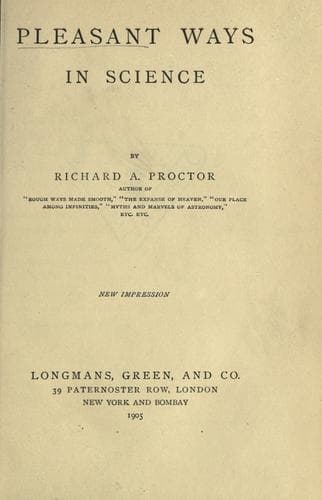
Pleasant Ways in ScienceProctor, Richard A. (Richard Anthony)
Science
Pleasant Ways in Science
Proctor, Richard A. (Richard Anthony)
Science
Huggins tried to recognize by the new method the effects of the sun’s
rotation, using a much more powerful spectroscope than Secchi’s. The
history of the particular spectroscope he employed is in one respect
specially interesting to myself, as the extension of spectroscopic
power was of my own devising before I had ever used or even seen a
powerful spectroscope. The reader is aware that spectroscopes derive
their light-sifting power from the prisms forming them. The number
of prisms was gradually increased, from Newton’s single prism to
Fraunhofer’s pair, and to Kirchhoff’s battery of four, till six were
used, which bent the light round as far as it would go. Then the idea
occurred of carrying the light to a higher level (by reflections)
and sending it back through the same battery of prisms, doubling the
dispersion. Such a battery, if of six prisms, would spread the spectral
colours twice as widely apart as six used in the ordinary way, and
would thus have a dispersive power of twelve prisms. It occurred
to me that after taking the rays through six prisms, arranged in a
curve like the letter C, an intermediate four-cornered prism of a
particular shape (which I determined) might be made to send the rays
into another battery of six prisms, the entire set forming a double
curve like the letter S, the rays being then carried to a higher level
and back through the double battery. In this way a dispersive power of
nineteen prisms could be secured. My friend, Mr. Browning, the eminent
optician, made a double battery of this kind,[13] which was purchased
by Mr. W. Spottiswoode, and by him lent to Mr. Huggins for the express
purpose of dealing with the task Secchi had set spectroscopists. It
did not, however, afford the required evidence. Huggins considered
the displacement of dark lines due to the sun’s rotation to be
recognizable, but so barely that he could not speak confidently on the
point.
There for a while the matter rested. Vögel made observations confirming
Huggins’s results relative to stellar motions; but Vögel’s instrumental
means were not sufficiently powerful to render his results of much
weight.
But recently two well-directed attacks have been made upon this
problem, one in England, the other in America, and in both cases with
success. Rather, perhaps, seeing that the method had been attacked and
was supposed to require defence, we may say that two well-directed
assaults have been made upon the attacking party, which has been
completely routed.
Public-domain text, read in full here on John Shaqi.
Reviews
Reviews
No reviews yet
Be the first to share your thoughts on this work.
Elsewhere in the archive
Join the Discussion
Join the discussion
Sign in to leave a comment or review.
Sign InorCreate an account