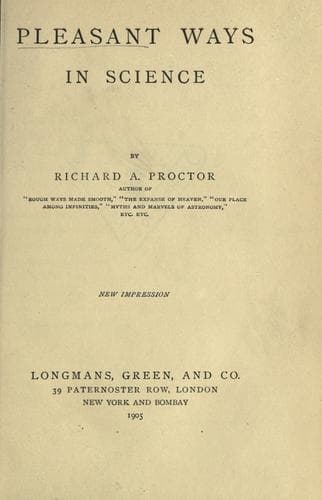
Pleasant Ways in ScienceProctor, Richard A. (Richard Anthony)
Science
Pleasant Ways in Science
Proctor, Richard A. (Richard Anthony)
Science
Arrangements were made not very long ago, by which the astronomical
work of Greenwich Observatory, for a long time directed almost
exclusively to time observations, should include the study of the sun,
stars, planets, and so forth. Amongst other work which was considered
suited to the National Observatory was the application of spectroscopic
analysis to determine motions of recession and approach among the
celestial bodies. Some of these observations, by the way, were made, we
are told, “to test the truth of Doppler’s principle,” though it seems
difficult to suppose for an instant that mathematicians so skilful as
the chief of the Observatory and some of his assistants could entertain
any doubt on that point. Probably it was intended by the words just
quoted to imply simply that some of the observations were made for the
purpose of illustrating the principle of the method. We are not to
suppose that on a point so simple the Greenwich observers have been in
any sort of doubt.
At first their results were not very satisfactory. The difficulties
which had for a long time foiled Huggins, and which Secchi was never
able to master, rendered the first Greenwich measures of stellar
motions in the line of sight wildly inconsistent, not only with
Huggins’s results, but with each other.
Secchi was not slow to note this. He renewed his objections to the new
method of observation, pointing and illustrating them by referring to
the discrepancies among the Greenwich results. But recently a fresh
series of results has been published, showing that the observers
at Greenwich have succeeded in mastering some at least among the
difficulties which they had before experienced. The measurements
of star-motions showed now a satisfactory agreement with Huggins’s
results, and their range of divergence among themselves was greatly
reduced. The chief interest of the new results, however, lay in the
observations made upon bodies known to be in motion in the line of
sight at rates already measured. These observations, though not wanted
as tests of the accuracy of the principle, were very necessary as tests
of the qualities of the instruments used in applying it. It is here and
thus that Secchi’s objections alone required to be met, and here and
thus they have been thoroughly disposed of. Let us consider what means
exist within the solar system for thus testing the new method.
Public-domain text, read in full here on John Shaqi.
Reviews
Reviews
No reviews yet
Be the first to share your thoughts on this work.
Elsewhere in the archive
Join the Discussion
Join the discussion
Sign in to leave a comment or review.
Sign InorCreate an account