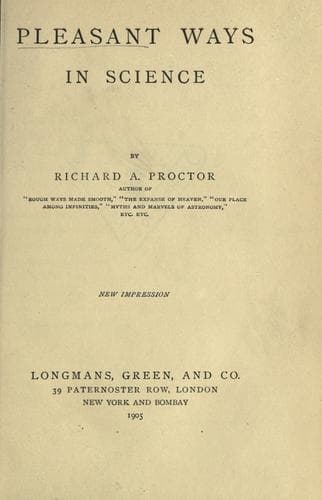
Pleasant Ways in ScienceProctor, Richard A. (Richard Anthony)
Science
Pleasant Ways in Science
Proctor, Richard A. (Richard Anthony)
Science
If Young had been measuring the motion of the same matter which is
observed with the telescope, there could of course be no doubt that
the telescope was right and the spectroscope wrong. We might add a
few yards per second for the probably greater distance of the sun
resulting from recent transit observations. For of course with an
increase in our estimate of the sun’s distance there comes an increase
in our estimate of the sun’s dimensions, and of the velocity of the
rotational motion of his surface. But only about 12 yards per second
could be allowed on this account; the rest would have to be regarded
as an error due to the difficulties involved in the spectroscopic
method. In reality, however, the telescopist and the spectroscopist
observe different things in determining by their respective methods
the sun’s motion of rotation. The former observes the motion of the
spots belonging to the sun’s visible surface; the latter observes the
motion of the glowing vapours outside that surface, for it is from
these vapours, not from the surface of the sun, that the dark lines
of the spectrum proceed. Now so confident is Professor Young of the
accuracy of his spectroscopic observations, that he is prepared to
regard the seeming difference of velocity between the atmosphere and
surface of the sun as real. He believes that “the solar atmosphere
really sweeps forward over the underlying surface, in the same way
that the equatorial regions outstrip the other parts of the sun’s
surface.” This inference, important and interesting in itself, is far
more important in what it involves. For if we can accept it, it follows
that the spectroscopic method of measuring the velocity of motions in
the line of sight is competent, under favourable conditions, to obtain
results accurate within a few hundred yards per second, or 10 or 12
miles per minute. If this shall really prove to be true for the method
now, less than ten years after it was first successfully applied,
what may we not hope from the method in future years? Spectroscopic
analysis itself is in its infancy, and this method is but a recent
application of spectroscopy. A century or so hence astronomers will
smile (though not disdainfully) at these feeble efforts, much as we
smile now in contemplating the puny telescopes with which Galileo and
his contemporaries studied the star-depths. And we may well believe
that largely as the knowledge gained by telescopists in our own
time surpasses that which Galileo obtained, so will spectroscopists
a few generations hence have gained a far wider and deeper insight
into the constitution and movements of the stellar universe than the
spectroscopists of our own day dare even hope to attain.
Public-domain text, read in full here on John Shaqi.
Reviews
Reviews
No reviews yet
Be the first to share your thoughts on this work.
Elsewhere in the archive
Join the Discussion
Join the discussion
Sign in to leave a comment or review.
Sign InorCreate an account