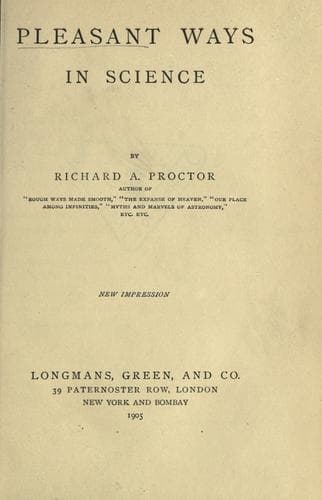
Pleasant Ways in ScienceProctor, Richard A. (Richard Anthony)
Science
Pleasant Ways in Science
Proctor, Richard A. (Richard Anthony)
Science
Lastly, there remains the rotation of the sun, a movement much more
difficult to detect by the new method, because the actual rate of
motion even at the sun’s equator amounts only to about 1 mile per
second.
In dealing with this very difficult task, the hardest which
spectroscopists have yet attempted, the Greenwich observers have
achieved an undoubted success; but unfortunately for them, though
fortunately for science, another observatory, far smaller and of much
less celebrity, has at the critical moment achieved success still more
complete.
The astronomers at our National Observatory have been able to recognize
by the new method the turning motion of the sun upon his axis. And
here we have not, as in the case of Venus, to record merely that the
observers have seen what they expected to see because of the known
motion of the sun. “Particular care was taken,” says Airy, “to
avoid any bias from previous knowledge of the direction in which a
displacement” (of the spectral lines) “was to be expected,” the side of
the sun under observation not being known by the observer until after
the observation was completed.
But Professor Young, at Dartmouth College, Hanover, N.H., has done much
more than merely obtain evidence by the new method that the sun is
rotating as we already knew. He has succeeded so perfectly in mastering
the instrumental and observational difficulties, as absolutely to be
able to rely on his _measurement_ (as distinguished from the mere
recognition) of the sun’s motion of rotation. The manner in which he
has extended the powers of ordinary spectroscopic analysis, cannot very
readily be described in these pages, simply because the principles on
which the extension depends require for their complete description a
reference to mathematical considerations of some complexity. Let it be
simply noted that what is called the diffraction spectrum, obtained
by using a finely lined plate, results from the dispersive action
of such a plate, or _grating_ as it is technically called, and this
dispersive power can be readily combined with that of a spectroscope
of the ordinary kind. Now Dr. Rutherfurd, of New York, has succeeded
in ruling so many thousand lines on glass within the breadth of a
single inch as to produce a grating of high dispersive power. Availing
himself of this beautiful extension of spectroscopic powers, Professor
Young has succeeded in recognizing effects of much smaller motions
of recession and approach than had before been observable by the new
method. He has thus been able to measure the rotation-rate of the sun’s
equatorial regions. His result exceeds considerably that inferred from
the telescopic observation of the solar spots. For whereas from the
motion of the spots a rotation-rate of about 1¼ mile per second has
been calculated for the sun’s equator, Professor Young obtains from his
spectroscopic observations a rate of rather more than 1⅖ mile, or about
300 yards per second more than the telescopic rate.
Public-domain text, read in full here on John Shaqi.
Reviews
Reviews
No reviews yet
Be the first to share your thoughts on this work.
Elsewhere in the archive
Join the Discussion
Join the discussion
Sign in to leave a comment or review.
Sign InorCreate an account