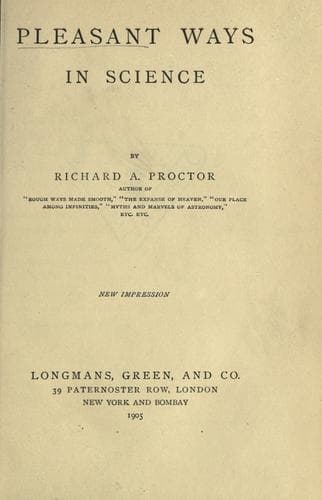
Pleasant Ways in ScienceProctor, Richard A. (Richard Anthony)
Science
Pleasant Ways in Science
Proctor, Richard A. (Richard Anthony)
Science
“The ignited hydrogen gas in burning produced the light corresponding
to the two bright bands in the red and green; the remaining bright
lines were not, however, coincident with those of oxygen, as might have
been expected. According to this theory, the burning hydrogen must have
greatly increased the heat of the solid matter of the photosphere and
brought it into a state of more intense incandescence and luminosity,
which may explain how the formerly faint star could so suddenly assume
such remarkable brilliance; the liberated hydrogen became exhausted,
the flame gradually abated, and with the consequent cooling the
photosphere became less vivid, and the star returned to its original
condition.”
According to the other theory, advanced by Meyer and Klein, the
blazing forth of this new star may have been occasioned by the violent
precipitation of some great mass, perhaps a planet, upon a fixed star,
“by which the momentum of the falling mass would be changed into
molecular motion,” and result in the emission of light and heat.
“It might even be supposed that the new star, through its rapid motion,
may have come in contact with one of the nebulæ which traverse in great
numbers the realms of space in every direction, and which from their
gaseous condition must possess a high temperature; such a collision
would necessarily set the star in a blaze, and occasion the most
vehement ignition of its hydrogen.”
If we regard these two theories in their more general aspect,
considering one as the theory that the origin of disturbance was within
the star, and the other as the theory that the origin of disturbance
was outside the star, they seem to include all possible interpretations
of the observed phenomena. But, as actually advanced, neither seems
satisfactory. The sudden pouring forth of hydrogen from the interior,
in quantities sufficient to explain the outburst, seems altogether
improbable. On the other hand, as I have pointed out elsewhere, there
are reasons for rejecting the theory that the cause of the heat which
suddenly affected this star was either the downfall of a planet on
the star or the collision of the star with a star-cloudlet or nebula,
traversing space in one direction, while the star rushed onwards in
another.
Public-domain text, read in full here on John Shaqi.
Reviews
Reviews
No reviews yet
Be the first to share your thoughts on this work.
Elsewhere in the archive
Join the Discussion
Join the discussion
Sign in to leave a comment or review.
Sign InorCreate an account